A client will often open a conversation with "we want to use AI for this," describing a process that, once we actually map it out, turns out to need plain rule-based automation — not AI at all. The reverse happens too: a business builds a rigid, rule-based automation for a process that genuinely needs judgment and pattern recognition, and it breaks constantly because real-world cases don't fit its fixed rules. Both mistakes come from the same root cause: treating "AI" and "automation" as interchangeable buzzwords instead of two genuinely different tools that solve different kinds of problems.
Automation is the right tool when a process is repetitive, rule-based, and the correct action is always the same given the same inputs — an order gets placed, an inventory system checks stock, an invoice generates automatically, a confirmation email sends. There's no judgment call being made anywhere in that sequence; it's the same deterministic steps every time, and the entire value is doing them without a human repeating the same manual action hundreds of times. This is exactly the kind of work tools like Zoho Flow, or custom workflow logic, handle extremely well and inexpensively, and trying to solve it with an AI model is genuinely overkill — you'd be adding cost, latency, and unpredictability to a problem that doesn't need any judgment at all.
AI earns its place specifically where judgment, pattern recognition, or handling genuinely variable input is required — reading an unstructured document and extracting the relevant fields regardless of layout, predicting which customer accounts are at risk of churning based on subtle behavior patterns a fixed rule could never capture, or handling a customer support question phrased a hundred different ways where a rigid decision tree would miss most of them. The signal that you actually need AI, not automation, is that you cannot write down a fixed rule that correctly handles every case — the correct response genuinely depends on nuance in the specific input.
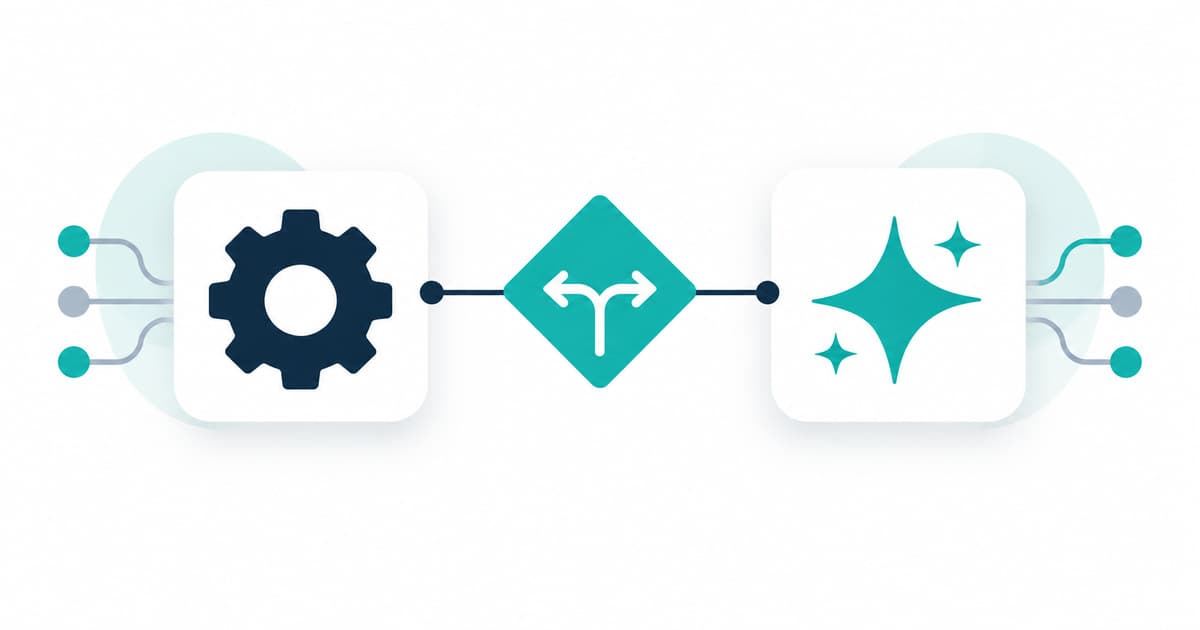
The businesses that get the best return combine both, in the right order: automation handles the deterministic parts of a workflow reliably and cheaply, and AI is layered in specifically at the point where judgment is actually required, with automation handling everything before and after it. A churn-prediction model (AI) feeding into an automated outreach sequence (automation) is a good example — the model does the one thing only AI can do well, deciding who's at risk, and automation handles the reliable, repetitive follow-through once that judgment call is made. Using AI for the follow-through too would just make the reliable part slower and less predictable for no benefit.
Our actual process with clients starts by mapping the full workflow step by step and asking, honestly, at each step: does the correct action here ever change based on nuance in the input, or is it always the same given the same trigger. Steps where the answer is "always the same" get automated, cheaply and reliably. Steps where the answer is "it depends on judgment" are where we scope AI, specifically and narrowly, rather than wrapping the whole process in AI because it sounds more impressive. That discipline is what determines whether you get a system that's fast, reliable, and genuinely cost-effective, or one that's needlessly complex, slower than it needs to be, and expensive to maintain for capability you were never actually using.