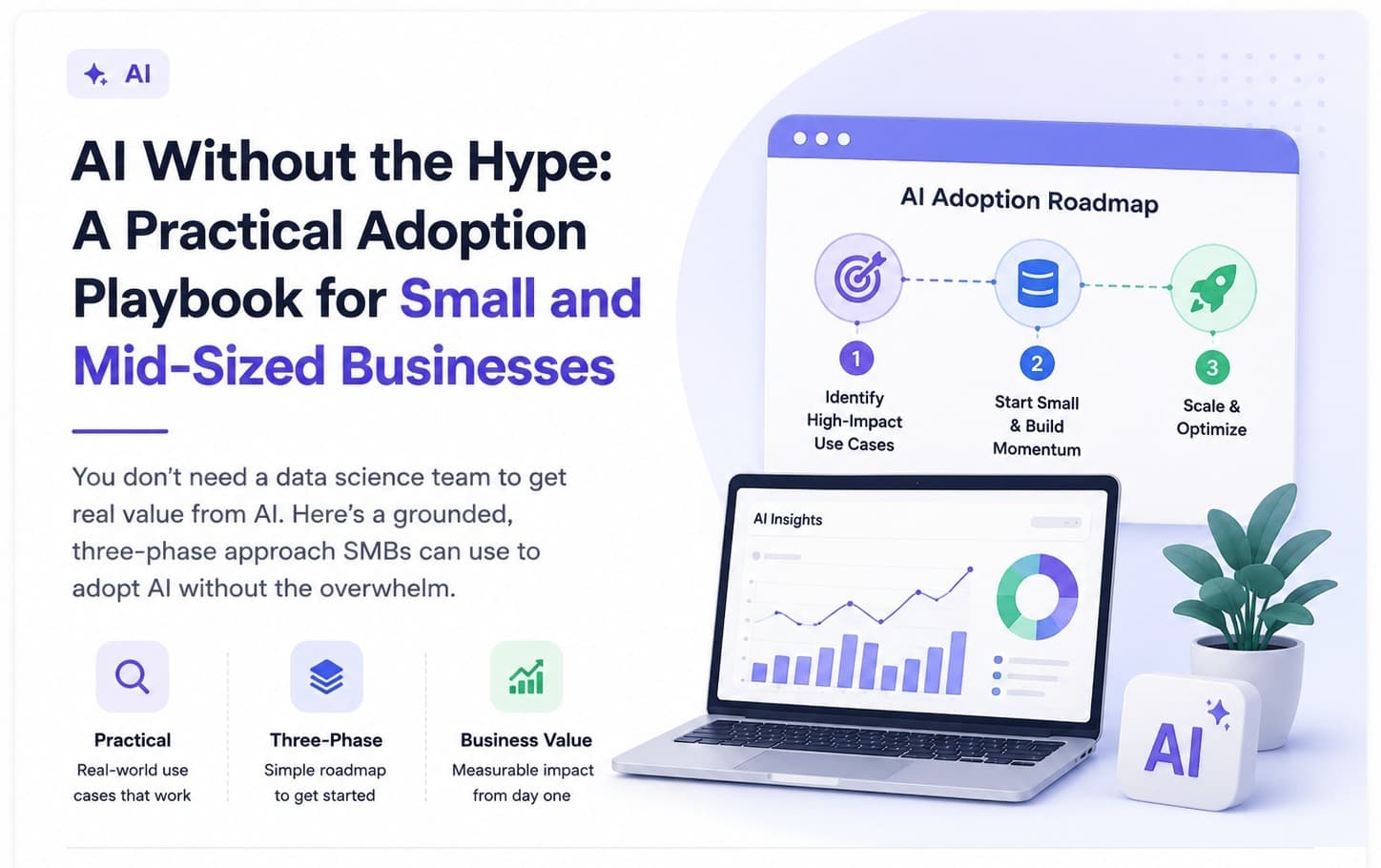
Every SMB owner has, by now, sat through a pitch promising that AI will transform their business. Most of those pitches are vague on purpose, because specificity would reveal how narrow the actual use case is. The businesses that get genuine value from AI in 2026 aren't the ones chasing the most impressive demo — they're the ones who picked one boring, well-defined, repetitive problem and automated it properly. AI adoption succeeds or fails on problem selection far more than on model quality.
The first phase of any sensible AI rollout is an inventory of repetitive judgment calls — the small decisions your team makes dozens of times a day that follow a pattern but still require a human to read something and decide. Categorizing support tickets, drafting first-pass responses to common inquiries, extracting line items from supplier invoices, flagging unusual transactions for review — these are ideal candidates because they're bounded, they have historical examples to learn from, and getting them 80% right still saves meaningful time even before the system is perfect. Contrast this with open-ended goals like "use AI to improve customer experience," which sound strategic but give a project team nothing concrete to build or measure.
The second phase is building a thin, reviewable pilot rather than a comprehensive system. We push clients toward what we call a "human-in-the-loop first" pilot: the AI produces a draft — a categorization, a summary, a suggested reply — and a person reviews and approves it before anything ships. This does two things at once. It protects you from the embarrassing failure modes that any AI system will occasionally produce, and it generates exactly the kind of labeled correction data you need to measure and improve accuracy over time. Skipping straight to full automation is how companies end up with AI-generated customer emails that never should have gone out.
The third phase is measurement against a real baseline, not a vibe. Before deploying anything, time how long the task currently takes a human and how often the current process produces errors. After the pilot runs for a few weeks, compare directly: how many items needed correction, how much time did the reviewer actually spend, and what's the fully-loaded cost per item now versus before. This is where a lot of AI initiatives quietly die, because when measured honestly, an impressive-looking demo sometimes saves less time than expected once review overhead is included. That's a legitimate, useful finding — better to learn it in a four-week pilot than after a year-long contract.
On the technology side, SMBs increasingly don't need to train their own models at all. A well-instructed large language model connected to your own data through retrieval, combined with clear business rules for what needs human review, covers the vast majority of practical use cases we implement — document extraction, ticket triage, meeting summarization, basic reporting narratives. Custom model training is rarely justified until you have a very high-volume, very specific task where an off-the-shelf model's accuracy genuinely isn't good enough, and even then it usually means fine-tuning rather than training from scratch.
The businesses we've seen succeed with AI share a common trait: they treat it as an operations improvement project with a technology component, not a technology project that happens to touch operations. Start with the process, not the model. Measure honestly. Keep a human in the loop until the numbers earn the right to remove one. That discipline, more than any particular tool or vendor, is what separates AI adoption that pays for itself from AI adoption that becomes next year's cautionary tale.