AI Engineering: Generative AI & Agentic AI
AI Engineering is a 14-week advanced program for Python developers who want to ship generative-AI products: LLM APIs and structured outputs, RAG with evaluation, tool-calling agents and MCP servers, guardrails and prompt-injection defence, cost and latency control, observability and deployment — all built into one support assistant for a D2C brand.
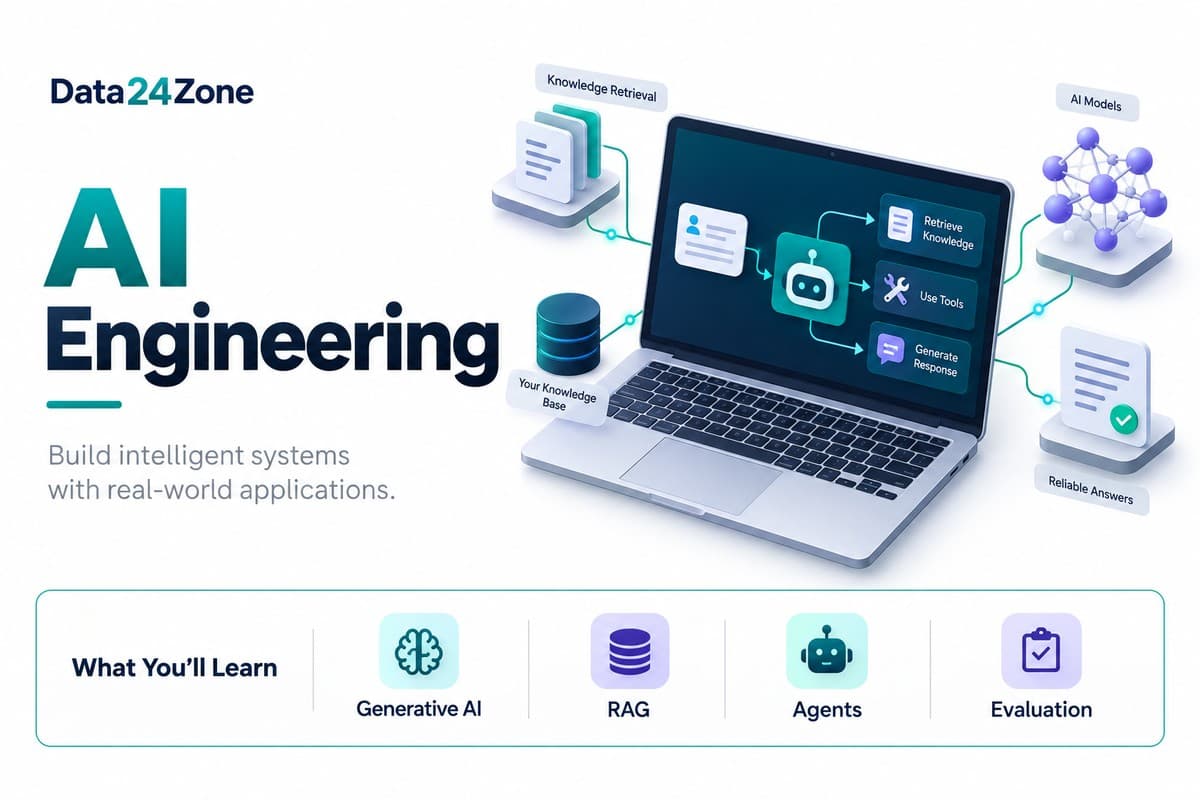
Build and ship production AI applications — LLM APIs, RAG with evaluation, tool-calling agents, MCP, guardrails and observability — rather than training models from scratch.
What you'll learn
Course details
Duration
14 weeks
Best for
Developers who already understand machine learning and deep learning fundamentals
Enrollment isn't open for this course yet — check back soon or contact us.
Course Curriculum
A module-by-module breakdown of what you'll cover in AI Engineering: Generative AI & Agentic AI.
01Week 0: Setup & how AI engineers work
5 topicsWeek 1
- AI engineer role vs ML engineer vs data scientist
- Spec → eval → build → ship lifecycle
- API keys, secrets and spend limits
- Git branching and PR reviews
- Portfolio: ThreadAssist GitHub repo: README, project spec (users, tasks, success metrics) and a working 'hello LLM' CLI
02Week 1: LLM APIs across providers
6 topicsWeek 2
- Tokens, context windows and pricing per token
- Transformer and embedding intuition (just enough to reason about behaviour)
- Sampling: temperature, top-p, max tokens
- Streaming, rate limits, retries with backoff
- Provider differences and a thin abstraction layer
- Portfolio: llm_client module: a multi-provider client with streaming, retries and a per-call cost/latency log, plus a comparison note
03Week 2: Prompt design + your first eval harness
6 topicsWeek 3
- System vs user instructions, roles and delimiters
- Few-shot examples and task decomposition
- Prompts as versioned code
- Golden datasets, exact-match and rubric scoring
- Comparing prompts/models with evidence, not vibes
- Portfolio: Ticket triage classifier with versioned prompts and an eval report (accuracy, confusion matrix, cost per 1k tickets)
04Week 3: Structured outputs & extraction APIs
6 topicsWeek 4
- JSON schema and Pydantic models
- Provider structured-output and tool-schema modes
- Validation, repair retries and fallbacks
- Field-level accuracy metrics
- Serving AI as an API
- Portfolio: /extract API returning validated JSON, with field-level accuracy on a labelled set
05Week 4: Embeddings, chunking & retrieval
6 topicsWeek 5
- Embeddings and similarity search
- Chunking strategies and metadata
- Hybrid search (BM25 + vectors) and reranking
- Retrieval metrics: recall@k, MRR
- Ingestion pipelines and re-indexing
- Portfolio: Retrieval service plus a retrieval eval report that shows which chunking, embedding and reranking settings won and why
06Week 5: RAG generation & RAG evaluation
6 topicsWeek 6
- Context assembly and token budgets
- Grounding, citations and 'I don't know' behaviour
- Faithfulness, answer relevance and context precision
- LLM-as-judge and calibrating it against human labels
- Failure analysis: retrieval miss vs generation error
- Portfolio: Policy Q&A bot with citations, plus a RAG eval report (faithfulness, relevance, refusal rate, judge-human agreement)
07Week 6: Tool calling & the agent loop
6 topicsWeeks 7–8
- Function/tool calling across providers
- The agent loop: plan, act, observe, stop
- State, max steps and timeouts
- Error handling and idempotent tools
- Human-in-the-loop approval for risky actions
- Portfolio: ThreadAssist support agent that resolves order queries end to end, with refunds gated behind approval
08Week 7: MCP-style tool integration
6 topicsWeek 9
- Model Context Protocol: servers, clients, tools, resources, prompts
- Transports (local stdio vs remote HTTP)
- Least privilege, auth and scoping tools
- Reusing one tool server across apps and assistants
- When MCP helps vs a direct API call
- Portfolio: kovai-mcp server repo with a demo GIF of two different clients using the same tools
09Week 8: Agent workflows, multi-agent patterns & agent evals
5 topicsWeek 10
- Workflows vs autonomous agents: choosing the simplest one that works
- Graph-based orchestration, checkpoints and memory
- Router → specialist → reviewer pattern
- Agent evals: task success, trajectory, tool-call accuracy, cost per task
- Portfolio: Multi-step ThreadAssist workflow plus an agent eval report comparing the plain loop and the graph on success rate, steps and cost
10Week 9: Guardrails, security & responsible AI
6 topicsWeek 11
- Direct and indirect prompt injection (through retrieved docs and tool output)
- PII detection and redaction; DPDP Act awareness
- Input/output filters and moderation
- Jailbreak red-teaming and abuse cases
- Bias and tone checks for customer-facing text
- Portfolio: Guardrail layer plus a red-team report (attacks tried, pass/fail before and after, residual risks)
11Week 10: Observability, cost & latency
7 topicsWeek 12
- Tracing spans for LLM, retrieval and tool calls
- Prompt/version tracking and user feedback capture
- Exact and semantic caching; provider prompt caching
- Model routing (small vs large, local vs hosted)
- Token budgets, batching and p50/p95 latency
- Prompt vs RAG vs fine-tune decision guide
- Portfolio: Cost & latency report: before/after p95, cost per conversation, and quality held constant on the eval suite
12Week 11: Shipping: containers, deployment & CI eval gates
6 topicsWeek 13
- Backend structure, config and secrets in deployment
- Docker images and health checks
- Deploying to a free hosting tier
- CI: tests + eval suite as a regression gate
- Rollbacks, prompt/version pinning and a basic incident runbook
- Portfolio: Live ThreadAssist demo URL plus a CI pipeline with an eval gate and a one-page runbook
13Weeks 12–13: Capstone + AI engineer careers
5 topicsWeek 14
- Scoping an AI feature with success metrics
- Writing an eval-first design doc
- Telling a portfolio story: problem, metrics, tradeoffs
- AI engineer interview loops
- Portfolio: Capstone repo, live demo, demo video, design doc and polished GitHub/LinkedIn portfolio
Tools & Technologies
Hands-on practice with the same tools used by working professionals.
Need this built for your business instead?
If you'd rather have it done than learn it, our solutions team delivers this work for businesses directly.
Real-Time, Industry-Based Projects
This is project-based learning modeled on real industry scenarios — you'll build portfolio-ready work as you go, not just watch lectures.
Every course includes a guided internship on top of your project work — so you graduate with real experience, not just a certificate.
Communication & Soft Skills
Built into every course, alongside the technical curriculum.
Communication Skills
Practice explaining technical work clearly to teammates, managers, and clients.
Practical AI Skills
Hands-on training in using AI tools well — prompting, everyday workflows, and where AI actually helps versus where it doesn't.
Teamwork & Collaboration
Work in small project teams using real workflows like stand-ups and code reviews.
Problem Solving
Build the habit of breaking down ambiguous problems into clear, solvable steps.
Time Management
Learn to plan, prioritize, and deliver project work against realistic deadlines.
Presentation Skills
Present your project work and results with confidence, as you would to a client.
Resume & Profile Building
Build a strong resume, LinkedIn profile, and project portfolio that recruiters notice.
Interview Preparation
Mock interviews and portfolio reviews to get you ready for real job applications.
Career & Placement Support
Students enrolled in AI Engineering: Generative AI & Agentic AI get access to these placement-support tools and guidance. This is support and preparation, not a guaranteed job outcome.
Resume Builder
A resume auto-built from your real completed projects and certificates, ready to export.
Shareable Portfolio
A public portfolio page showcasing your approved projects, with a link you can share with employers.
Interview Preparation
Guidance on presenting your projects and experience clearly in real interviews.
Peer & Mentor Community
Ongoing access to our learner community for questions, feedback, and support after you finish.
What Your Certificates Look Like
Real, verifiable certificates with your name, AI Engineering: Generative AI & Agentic AI, and a QR code anyone can scan to confirm they're genuine — one for completing the course, and a separate one if you take the internship track. Certificates are included with Live and Recorded enrolments. For free courses, self-paced courses and internship tracks, earning a certificate is free and there's a one-time ₹100 fee to release it for viewing, download and sharing.
Course Completion Certificate

 Data24Zone
Certificate of Completion
Illustrative recipient
Your Name Here
Example certificate for completion of
AI Engineering: Generative AI & Agentic AI
- Certificate No.
- D24-SAMPLE
- Mode
- Self-Paced
- Duration
- 14 weeks
- Example issue date
- On completion
Sample only — not a real, issued certificate.
Verification is available only on issued certificates.
Internship Completion Certificate
Data24ZoneCertificate of Internship
Illustrative recipient
Your Name Here
Example certificate for completion of
AI Engineering: Generative AI & Agentic AI
- Certificate No.
- D24-SAMPLE
- Mode
- Internship
- Duration
- 14 weeks
- Example issue date
- On completion
Sample only — not a real, issued certificate.
Verification is available only on issued certificates.
Frequently Asked Questions
What does an AI engineer do?
An AI engineer builds software products on top of machine learning and large language models — integrating model APIs, designing prompts and structured outputs, building retrieval (RAG) systems and agents, and deploying, evaluating, and monitoring them in production.
What is the difference between AI engineering and data science?
Data science focuses on analysing data and building models. AI engineering focuses on turning models — especially LLMs — into reliable applications: APIs, RAG pipelines, agents, deployment, cost control, and evaluation. The AI Engineering program is built around that application-building path.
Do I need to know Python for AI engineering?
Yes, Python is the main language. The program opens with an AI Engineering and Software Foundations part covering Python engineering, APIs, Git, and containers before moving into ML, LLMs, RAG, and agents. It is an advanced program, so prior programming experience helps.
What will I learn in the AI Engineering: Generative AI & Agentic AI course?
You'll learn: LLM APIs, prompt design and structured outputs, evaluated from day one; Retrieval-augmented generation (RAG) measured with real evals; Tool-calling agents, MCP servers and multi-step workflows; Guardrails, observability, cost control and deployment.
What tools and technologies does the AI Engineering: Generative AI & Agentic AI course cover?
This course covers: Python, FastAPI, Pydantic, OpenAI API, Anthropic Claude API, Ollama (open models), Model Context Protocol (MCP), LangGraph, PostgreSQL + pgvector, Ragas, promptfoo, Langfuse, Docker, GitHub Actions, Streamlit / Gradio, Git & GitHub, GitHub Copilot / Claude / ChatGPT.
Is the AI Engineering: Generative AI & Agentic AI course beginner-friendly?
This is a advanced-level course, so it assumes some prior familiarity with the subject.
How long does the AI Engineering: Generative AI & Agentic AI course take to complete?
The course is designed to be completed in approximately 14 weeks, depending on your pace.
What enrollment options are available for AI Engineering: Generative AI & Agentic AI?
Live Class (₹19,999) — Instructor-led live cohort with doubt-clearing sessions — earns both the course and internship certificates (included). Recorded Batch (₹9,999) — Full recordings of a completed live batch — earns both the course and internship certificates (included). Internship Track (₹2,999) — Defined project-based internship track; deliverables and review schedule confirmed before payment. Self-Paced (₹2,999) — Learn anytime with the full recorded curriculum and community access.
Is there an internship option for AI Engineering: Generative AI & Agentic AI?
Yes — enrolling in the Internship track (or the Live/Recorded tracks, which include it) means working through real projects with our team and earning a separate Internship Certificate, in addition to the course completion certificate for Live/Recorded enrollments.
Will I get a certificate after completing AI Engineering: Generative AI & Agentic AI?
Yes. Self-paced enrollment earns a course completion certificate once your final project is reviewed and approved. Internship enrollment earns an internship certificate once your internship projects are approved. Live and Recorded enrollments earn both. Every certificate is publicly verifiable on our website and can be added directly to your LinkedIn profile. Certificates are included with Live and Recorded enrollments; for other options, earning a certificate is free and releasing it to view, download and share is a one-time ₹100 fee per certificate.
What kind of projects will I build in AI Engineering: Generative AI & Agentic AI?
You'll work on real projects such as: Capstone: ThreadAssist: production support copilot — Kovai Threads support is overloaded with order, return and COD queries; automate safe resolution with human approval for refunds; Capstone: Review & ticket insights pipeline — Product and ops teams need weekly structured insights (issue type, product, sentiment, root cause) from thousands of reviews and tickets at low cost; llm_client module: a multi-provider client with streaming, retries and a per-call cost/latency log, plus a comparison note; Ticket triage classifier with versioned prompts and an eval report (accuracy, confusion matrix, cost per 1k tickets); /extract API returning validated JSON, with field-level accuracy on a labelled set; Retrieval service plus a retrieval eval report that shows which chunking, embedding and reranking settings won and why.
Is placement support included with AI Engineering: Generative AI & Agentic AI?
Yes — every enrolled student gets full access to our placement support: resume building, a shareable project portfolio, mock interview preparation, and guidance applying what you've built to real job applications. This is support and access, not a guaranteed job outcome — how quickly it leads to an offer depends on the market and your own effort.