Most businesses don't set out to build a mess of disconnected tools — it happens gradually. A spreadsheet becomes a makeshift CRM. A free form builder becomes the intake system. A chat app becomes the support desk. Each choice feels reasonable at the time because it solves an immediate problem cheaply. The trouble starts eighteen months later, when none of these tools talk to each other, data lives in five places at once, and every new hire needs a half-day just to learn which system owns which piece of truth.
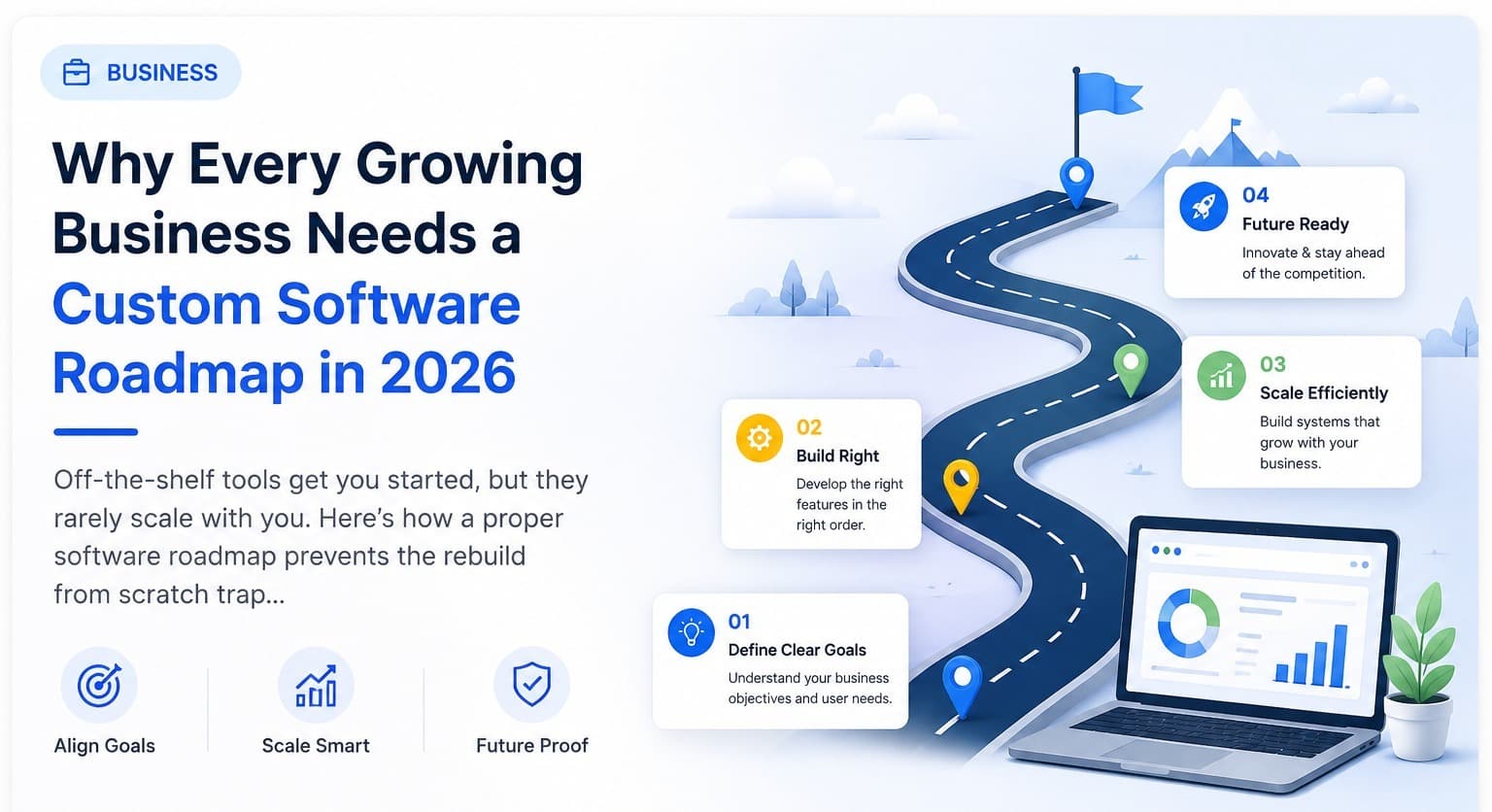
A software roadmap is simply the discipline of deciding, before you buy or build anything, what your systems need to look like in twelve, twenty-four, and thirty-six months — and then choosing today's tools so they fit that shape instead of fighting it. It doesn't mean over-engineering a startup with enterprise architecture on day one. It means asking three questions before every purchase: what data will this system own, what other systems will eventually need that data, and how hard will it be to get the data back out if we outgrow this tool. Answering those questions up front costs an afternoon. Answering them after the fact costs a migration project.
In our own client work at Data24Zone, the single most common expensive mistake we see is what we call "accidental platforms" — a business adopts a tool for one narrow purpose, and because it's convenient, keeps bolting more responsibilities onto it until it's quietly become the system of record for something it was never designed to handle. A scheduling tool becomes the customer database. A messaging app becomes the project tracker. These platforms are rarely built with export, API access, or integration in mind, so untangling them later means manual data re-entry, lost history, and weeks of reconciliation.
A good roadmap starts with a data model, not a tool list. Map out the core entities your business actually runs on — customers, orders, inventory, projects, whatever applies — and decide which system will be the single source of truth for each one before you evaluate any vendor. From there, tool selection becomes much simpler: you're no longer asking "which CRM has the nicest interface," you're asking "which CRM will let our data flow cleanly into the ERP and the support desk we'll need next year." This is also where API-first platforms and headless architectures earn their keep — a system that exposes clean APIs today is a system you can still connect to new tools you haven't even considered yet.
The roadmap also needs an honest cadence for revisiting itself. We recommend clients review their software stack every two quarters, treating it with the same seriousness as a financial audit. Ask what's grown past its original purpose, what integrations have become brittle, and where manual workarounds have crept back in — those workarounds are the clearest signal that a tool has been outgrown. Catching this during a scheduled review is inexpensive. Catching it during a customer-facing outage is not.
None of this requires a massive upfront investment or a big-bang replatforming project. The businesses that get this right treat their software stack as a living system that evolves in small, deliberate increments, guided by a shared picture of where the data needs to end up. That shared picture — more than any individual tool choice — is what a software roadmap actually gives you, and it's the difference between scaling smoothly and re-building your entire stack under pressure two years from now.