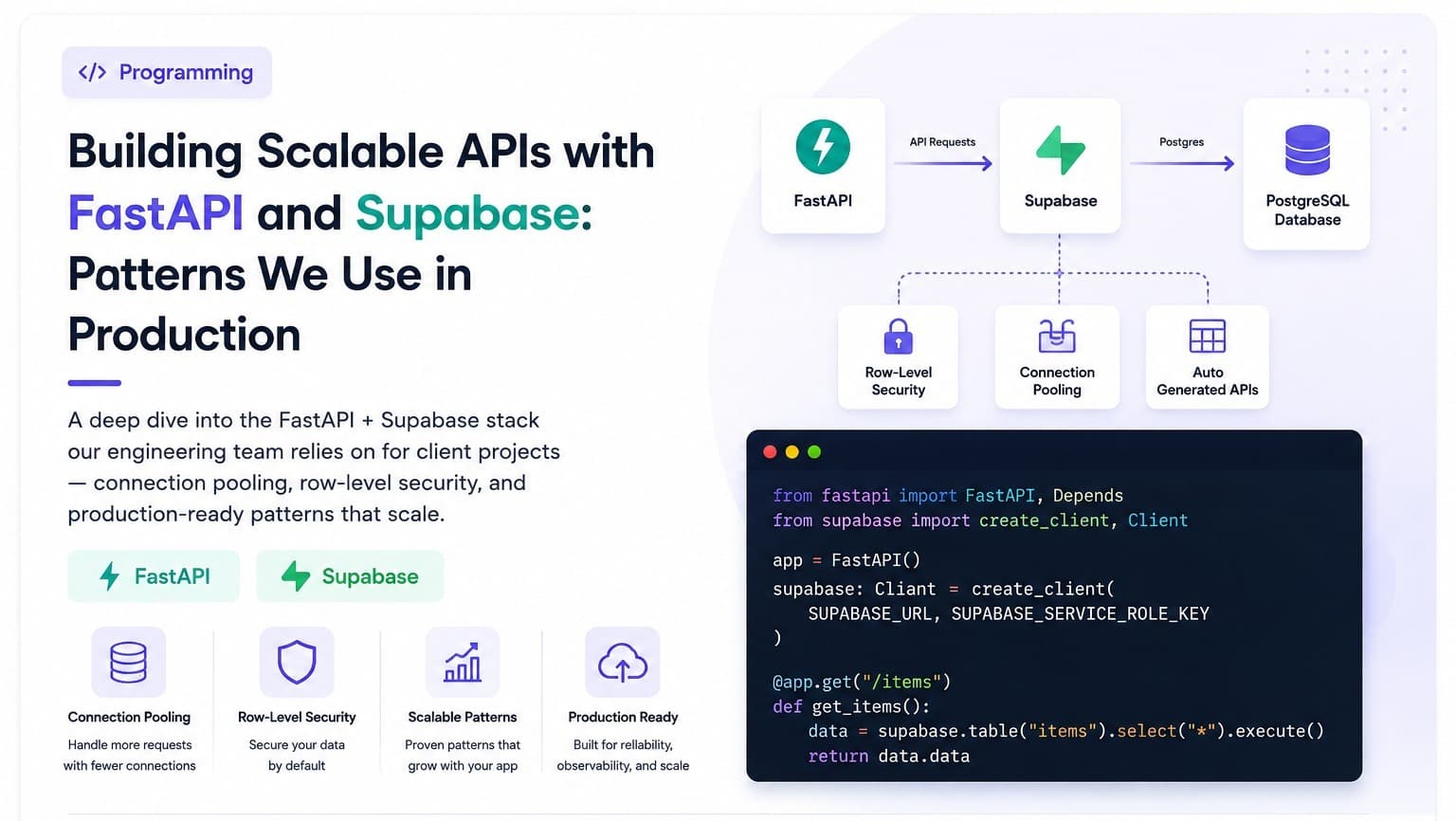
FastAPI and Supabase have become one of our default stacks for client APIs, and it's worth explaining why, because the reasoning matters more than the specific tools. FastAPI gives you async-first request handling, automatic OpenAPI documentation, and request/response validation through Pydantic with almost no boilerplate. Supabase gives you a managed Postgres database with built-in row-level security, auth, and realtime subscriptions. Together they let a small team ship a genuinely production-grade backend without standing up separate services for auth, database administration, and API documentation.
The first pattern worth getting right is connection management. Supabase's managed Postgres instance has a connection limit, and a naive FastAPI app that opens a new database connection per request will exhaust that limit under moderate load, especially if you're running multiple server instances. The fix is to use Supabase's connection pooler (PgBouncer, running in transaction mode) for your application traffic, and to configure your ORM or query layer — whether that's SQLAlchemy, asyncpg directly, or the Supabase Python client — to reuse a small, bounded pool of connections rather than opening one per request. We typically size pools conservatively, around 10-20 connections per service instance, and rely on horizontal scaling rather than fatter pools when load increases.
The second pattern is pushing authorization logic into the database itself via row-level security policies, rather than replicating it in application code. It's tempting to write "if user.role == admin" checks scattered across endpoints, but this duplicates logic and is easy to get wrong as the codebase grows. Instead, we define RLS policies directly on Supabase tables — for example, a policy that only lets a row be selected if its organization_id matches the requesting user's organization — and let Postgres enforce it at the data layer. FastAPI endpoints then just pass through the authenticated user's JWT, and the database guarantees isolation even if application code has a bug. This has caught real mistakes in code review that would otherwise have leaked data across tenants.
Background work is the third area teams get wrong early. Long-running tasks — sending emails, generating reports, calling a third-party AI API — should never block a request/response cycle. FastAPI's built-in BackgroundTasks is fine for very short fire-and-forget work, but for anything that can fail, needs retries, or takes more than a second or two, we reach for a proper task queue (Celery with Redis, or a lighter option like Supabase's own scheduled Edge Functions for simpler cron-style jobs). The API endpoint's job is to validate the request, enqueue the work, and return immediately with a job ID the client can poll or subscribe to via Supabase Realtime.
Testing this stack well means testing at two levels. Unit tests around Pydantic models and business logic functions should run without touching a real database at all — pure functions are cheap to test exhaustively. Integration tests, meanwhile, should run against a real (local or ephemeral) Postgres instance with the same RLS policies enabled as production, because RLS bugs are exactly the kind of thing that only shows up when policies and queries interact, not in isolated unit tests. We keep a docker-compose setup that spins up local Postgres with migrations and policies applied, specifically so integration tests exercise the same security boundary that protects production data.
None of these patterns are exotic, but getting them right from the start avoids the two failure modes we see most often in FastAPI + Supabase projects: connection exhaustion under real traffic, and authorization bugs that only surface once multiple customers share the same database. Build the pooling and the RLS policies in from day one, treat background work as a first-class concern rather than an afterthought, and this stack scales comfortably from a first client to a multi-tenant SaaS product without a rewrite.