When we started working with a mid-sized distribution client, their order processing looked like this: a sales rep would receive an order by email or WhatsApp, manually enter it into Zoho CRM, then re-enter the same information into their inventory system, then again into their accounting software to generate an invoice. Three separate manual entries for one order, done by three different people, with no guarantee any of them matched. The team wasn't careless — the process itself simply demanded triple data entry, and triple data entry inevitably produces mismatches.
The first step wasn't automation at all — it was mapping the actual workflow as it existed, warts and included. We sat with each team member for a half-day and documented every manual step, every workaround, and every "well, normally we do X, but if it's a rush order we do Y instead." This step is the one most automation projects skip, and it's why so many automation efforts fail: you cannot automate a process you don't fully understand, and most processes have more exceptions baked in than anyone remembers until you ask.
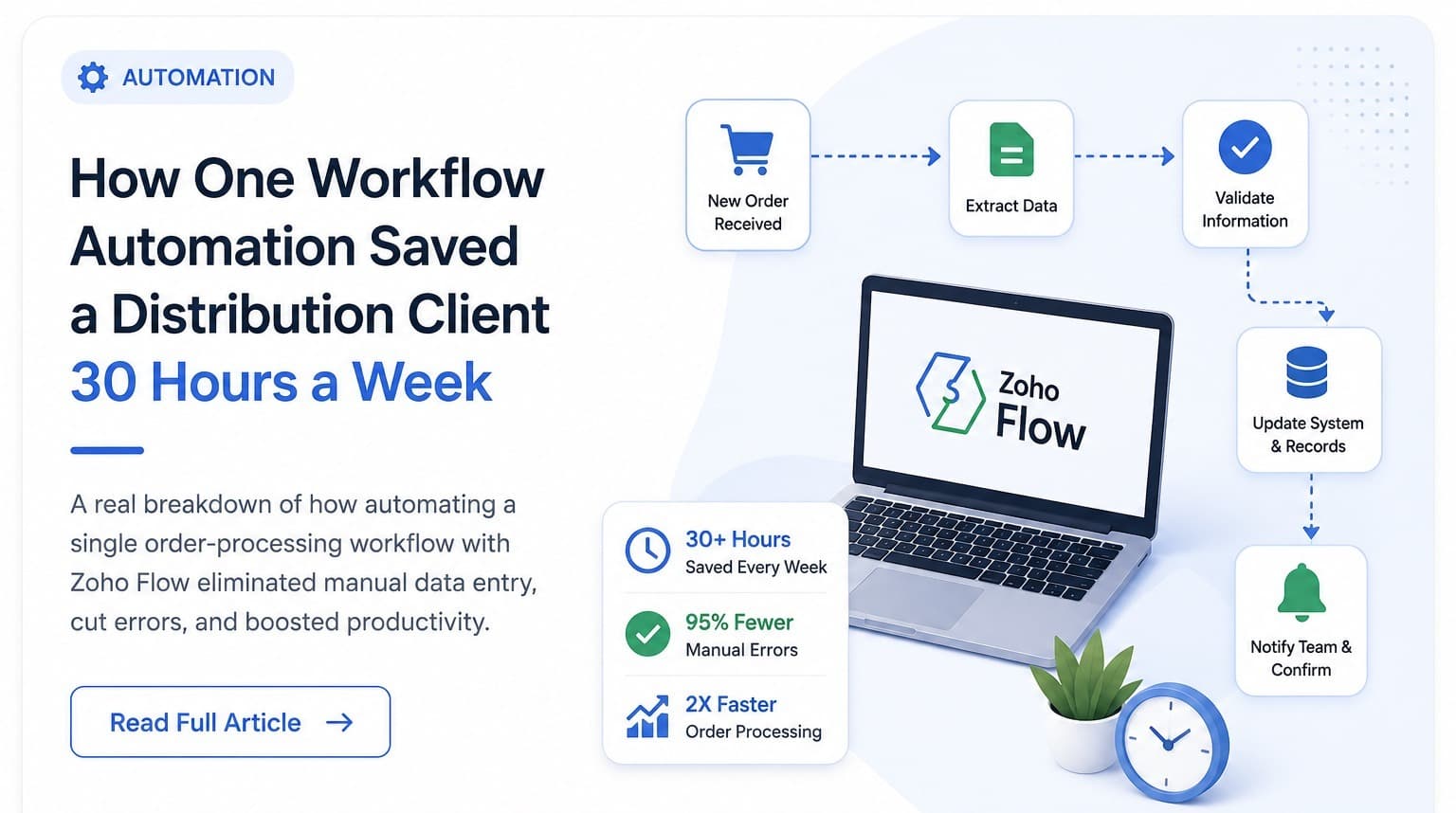
Once we had the real process mapped, we built a Zoho Flow automation that triggered the moment an order was created in the CRM. The flow validated the order against current inventory levels, automatically created the corresponding inventory reservation, generated the invoice in the accounting module with all line items pre-filled, and sent a confirmation to both the customer and the warehouse team — all within seconds of the original entry, with zero re-typing. Exception cases (rush orders, partial stock, custom pricing) were routed to a review queue rather than silently forced through the same path, which mattered just as much as automating the happy path.
The measured result after eight weeks: the three redundant data-entry steps collapsed into one, and the team's combined time spent on order processing dropped from roughly 38 hours a week to under 8. More significant than the raw hours was the error rate — mismatched inventory counts, which had been happening on approximately one in twelve orders, dropped to near zero, because the same validated data now flowed through every system instead of being retyped by different people at different times. Customer-facing invoice errors, which had been a recurring complaint, disappeared almost entirely in the same window.
What we'd emphasize to any business considering a similar project is that the time savings, while real, weren't actually the most valuable outcome. The bigger win was that the sales team stopped spending their attention on data entry and started spending it on actual sales conversations, and the operations team stopped firefighting reconciliation issues and started proactively managing inventory instead. Automation doesn't just save hours on paper — it changes what the freed-up hours get spent on, and in this case that shift showed up directly in the client's quarter-over-quarter order volume.
If there's a single lesson from this project worth generalizing, it's to automate the workflow with the most redundant manual entry first, not the workflow that feels the most "high-tech" to fix. Order processing isn't glamorous, but it was where the waste actually lived, and it's usually where it lives in most operationally-heavy businesses. Find where the same information gets typed more than once by more than one person, and that's where automation pays for itself fastest.