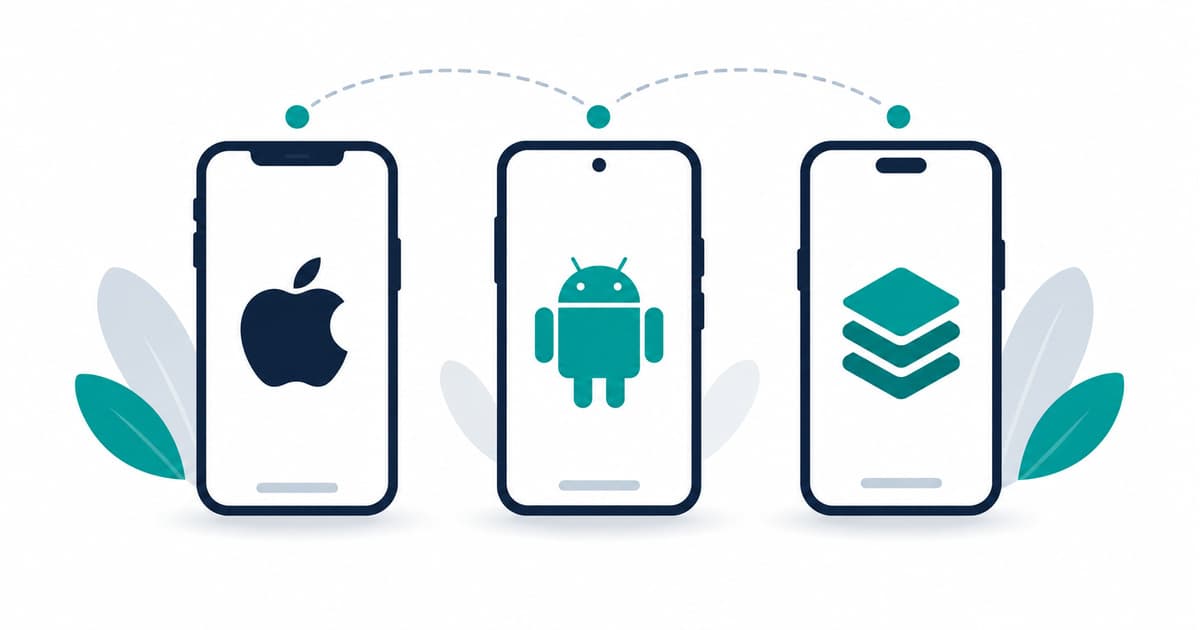
Ask five developers whether to build a mobile app natively or cross-platform, and you'll get five confident, contradictory answers, usually based on whatever stack that particular developer prefers working in. It's not a useful way to make the decision. The useful way is to work backward from what the app actually needs to do, because for the large majority of business apps, the honest answer is that cross-platform frameworks like React Native or Flutter get you to a genuinely excellent result faster and cheaper — and native development is the right call for a smaller, specific set of situations.
The first real question is how deep the app needs to go into device-specific capability. If you're building something that needs cutting-edge camera processing, complex AR features, or has to squeeze out every last bit of performance for something like a graphics-intensive game, native development (Swift for iOS, Kotlin for Android) still has an edge, because you're working directly against each platform's latest APIs without a cross-platform framework's abstraction layer in between. For the overwhelming majority of business apps — booking systems, field service tools, e-commerce, internal operations apps — this level of device-specific performance simply isn't the bottleneck, and building natively for it is solving a problem you don't have.
For nearly everything else, the real decision is between React Native and Flutter, and that decision comes down to your team and ecosystem more than any inherent technical superiority. React Native shares a language and many patterns with React web development, which means if your team (or an agency you'll work with long-term) already has strong React expertise, that knowledge transfers directly, and finding developers to maintain the app later is easier because the talent pool is larger. Flutter, built on Dart, tends to deliver more visually consistent UI across iOS and Android out of the box and can have a performance edge in animation-heavy interfaces, but it's a smaller talent pool to hire from later, which matters more than people expect when you're thinking five years out rather than just the initial build.
The question we push clients to answer honestly before any technology gets chosen is: who maintains this app after we ship it, and for how long. A cross-platform codebase, shared between iOS and Android, is dramatically cheaper to maintain long-term than two fully separate native codebases that both need every feature built twice and every bug fixed twice. Unless there's a specific, concrete technical reason you need native's device-level access, the long-term maintenance savings of one shared codebase usually outweighs whatever marginal performance edge native offers for a typical business app.
Our actual process: we map every planned feature against device capability requirements first, we ask honestly about your team's existing technical skills and hiring plans, and only then do we recommend a stack — and we're equally comfortable recommending React Native, Flutter, or native, because the right answer genuinely depends on your specific app and business, not on which framework a given developer happens to prefer working in. That discipline, more than any framework's marketing, is what determines whether the app you launch is still easy to maintain and extend three years from now.