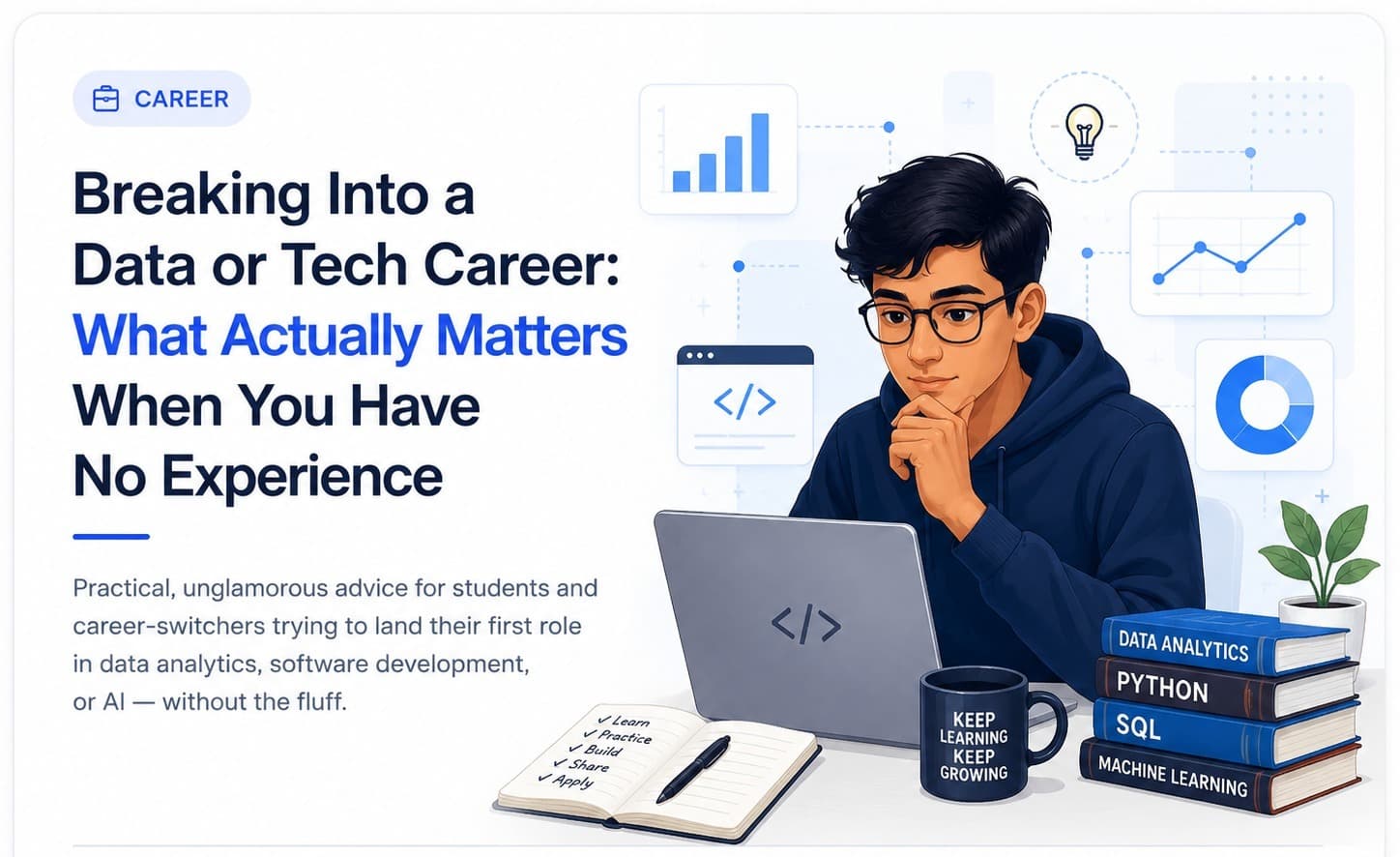
Every year we interview dozens of students and career-switchers trying to break into data and tech roles, and the same misconception shows up constantly: the belief that a longer list of certificates and courses is what gets you hired. It isn't. What actually gets a first-time candidate hired is evidence that they can do the job, even in miniature — and certificates, by themselves, are not evidence of that. A course completion certificate tells us you finished a course. A project tells us you can apply what you learned to something messy and real.
If you're trying to break into data analytics, the single highest-leverage thing you can do is find a genuinely messy, real dataset — government open data, a public API, even your own city's transit or weather data — and produce one honest, complete analysis from it: clean the data, deal with the missing values and inconsistencies that always exist in real datasets, build two or three visualizations that answer a specific question, and write up what you found in plain language. This matters more than working through ten more tutorial datasets that have already been cleaned for you, because tutorial datasets don't teach you the actual job, which is 70% cleaning and judgment calls and 30% analysis.
For software development roles, the equivalent move is contributing to or building something that has to keep running, not just something that runs once during a demo. A tutorial-following project that you build and then abandon shows you can follow instructions. A small tool you built for yourself or a local business, that you've had to fix bugs in over a few months, shows you understand what it actually means to maintain software — handling edge cases, fixing something that breaks in production, dealing with a user who does something you didn't anticipate. When we interview junior developers, we ask far more questions about what broke and how they fixed it than about what they built in the first place.
For AI-adjacent roles specifically, resist the pressure to claim deep expertise in building models from scratch, because very few entry-level roles actually require that, and overclaiming shows up immediately in an interview. What's far more valuable at the junior level is fluency with using existing models well — understanding prompt design, retrieval-augmented approaches, evaluation of model outputs, and the practical limitations of AI systems. Being able to explain clearly why a model failed on a particular input, and what you'd change, is a stronger signal than being able to recite transformer architecture from memory.
On the practical side: keep your portfolio to two or three genuinely complete projects rather than ten half-finished ones. A recruiter or hiring manager spends, realistically, two or three minutes looking at a portfolio before deciding whether to dig further, and a handful of finished, well-explained projects reads as far more credible than a long list of "in progress" repositories. Write a short explanation for each project — what problem it solved, what you'd do differently now — because the reflection matters as much as the project itself; it shows you can evaluate your own work honestly, which is exactly what you'll need to do on the job.
Finally, don't underestimate the value of structured, industry-oriented training over pure self-study, particularly if you're starting from zero. Self-study can absolutely work, but it takes longer to figure out what actually matters versus what's just interesting, and it's easy to spend months on topics that won't come up in your first year of real work. A good training program's real value isn't the certificate at the end — it's a curriculum built by people who've hired for these roles, that skips the detours and gets you to a genuine, defensible project faster. Whichever path you choose, the test is the same: can you point to something real you built, explain the decisions you made, and speak honestly about what didn't work. That's what gets you hired, not the length of your certificate list.