System Design: HLD, Scalability & Distributed Systems
System Design (HLD) is an 8-week advanced program where one payment-links product grows from a thousand merchants to ten million users: requirements and estimates, databases and caching, load balancing and rate limiting, queues and events, reliability, and LLM/RAG system design — with written design docs, a load-tested Docker prototype and recorded mock interviews.
Design systems that scale — caching, queues, databases, load balancing and AI services — with design docs, estimates and a working prototype you load-test.
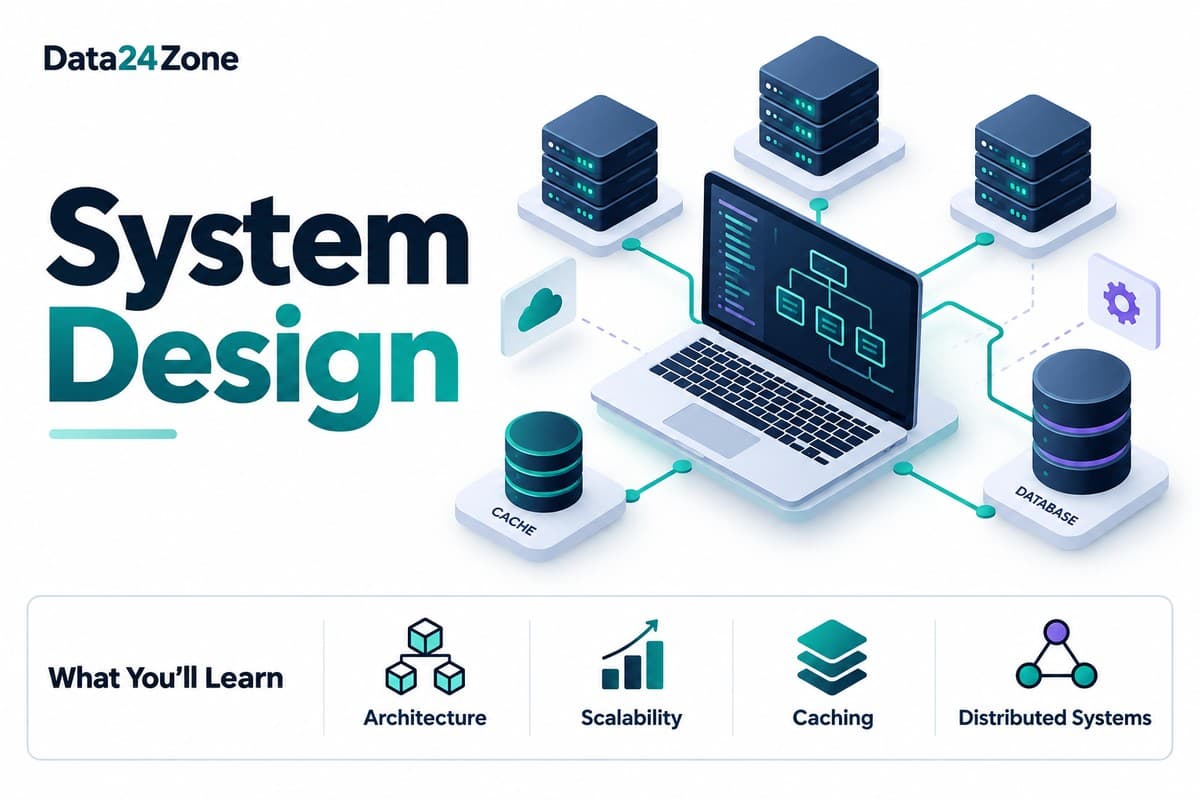
What you'll learn
Course details
Duration
8 weeks
Best for
Developers preparing for system design interviews or designing production architectures
Enrollment isn't open for this course yet — check back soon or contact us.
Course Curriculum
A module-by-module breakdown of what you'll cover in System Design: HLD, Scalability & Distributed Systems.
01Week 0: Setup and how engineers design systems
4 topicsWeek 1
- What HLD interviews and real design reviews look for
- Design-doc (RFC) structure: context, requirements, estimates, design, trade-offs, risks
- Diagram conventions: boxes, arrows, sync vs async
- Portfolio: Design-docs repo with template, PayLink v0 diagram and Docker Compose skeleton
02Week 1: Requirements, estimation and API design (PayLink v1: 10k merchants)
5 topicsWeek 2
- Functional vs non-functional requirements; SLAs
- Back-of-envelope: QPS, peak factor, storage, bandwidth
- Networking you need: DNS, HTTP, TLS, load balancer placement
- REST contracts, pagination, idempotency keys for payments; auth with OAuth2/JWT
- Portfolio: Design doc #1: requirements, estimate sheet, OpenAPI spec and v1 architecture diagram
03Week 2: Data modelling and storage; prototype v1: pay-link shortener
5 topicsWeek 3
- Relational modelling and indexes; reading EXPLAIN
- SQL vs NoSQL vs key-value: choosing by access pattern
- Short-code generation: base62 counter vs hash vs pre-generated keys
- Read replicas and connection pooling; PII fields and encryption at rest
- Portfolio: Working shortener in Docker Compose plus a database-choice trade-off table and data model diagram
04Week 3: Caching, load balancing and rate limiting (PayLink v2: 1M users)
5 topicsWeek 4
- Cache-aside, TTL, eviction, hot keys, stampede protection
- CDN for static storefront pages
- L4 vs L7 load balancing; stateless app servers
- Rate limiting: token bucket and sliding window in Redis
- Portfolio: Prototype v2 plus load-test report (p50/p95 latency, throughput, cache hit ratio, 429 rate)
05Week 4: Queues, streams and async work: analytics, webhooks and notifications
5 topicsWeek 5
- Queue vs log stream: RabbitMQ / Redis Streams vs Kafka
- At-least-once delivery, retries with backoff, dead-letter queues
- Idempotent consumers and the outbox pattern
- Fan-out for SMS, email and WhatsApp notifications
- Portfolio: Prototype v3 (queue + worker) with failure-injection demo, plus design doc #2: notification system
06Week 5: Distributed data and consistency (PayLink v3: 10M users)
5 topicsWeek 5
- Partitioning and sharding keys; consistent hashing
- Replication, quorum, CAP and PACELC in plain terms
- Distributed IDs (Snowflake-style); double-entry ledger
- Cross-service transactions: saga vs 2PC; exactly-once myths
- Portfolio: Design doc #3: PayLink ledger and sharding, with consistency trade-off table and simulator results
07Week 6: Real-time, service boundaries and reliability: merchant–customer chat
5 topicsWeek 6
- WebSockets, presence, message ordering and fan-out
- Monolith vs microservices; API gateway; when not to split
- Timeouts, retries, circuit breakers, bulkheads; multi-region, RPO/RTO
- Observability: metrics, logs, traces, SLOs and error budgets
- Portfolio: Design doc #4: real-time chat system, plus SLO dashboard and tested runbook
08Week 7: AI system design: RAG and agent support service; capstone kickoff
5 topicsWeek 7
- RAG pipeline: ingestion, chunking, embeddings, vector search, reranking
- LLM gateway: model routing, token budgets, timeouts, fallbacks
- Semantic caching and cost per query estimates
- Agents with tools: idempotent actions, human approval, guardrails, evals
- Portfolio: Design doc #5: PayLink AI support assistant with cost model, eval results and RAG prototype; capstone proposal approved
09Week 8: Capstone, mock design interviews and careers
4 topicsWeek 8
- The 45-minute HLD framework: requirements, estimates, API, data, deep dive, trade-offs
- Handling follow-ups and changing requirements
- Presenting design work on resume and GitHub
- Portfolio: Capstone repo with final design doc, prototype, load-test report, 5-minute demo video and two mock scorecards
Tools & Technologies
Hands-on practice with the same tools used by working professionals.
Want to learn just one piece first?
System Design: HLD, Scalability & Distributed Systems bundles all of these into one program — but each is also available as its own standalone course if you'd rather learn (or brush up on) a single skill first.
Real-Time, Industry-Based Projects
This is project-based learning modeled on real industry scenarios — you'll build portfolio-ready work as you go, not just watch lectures.
Every course includes a guided internship on top of your project work — so you graduate with real experience, not just a certificate.
Communication & Soft Skills
Built into every course, alongside the technical curriculum.
Communication Skills
Practice explaining technical work clearly to teammates, managers, and clients.
Practical AI Skills
Hands-on training in using AI tools well — prompting, everyday workflows, and where AI actually helps versus where it doesn't.
Teamwork & Collaboration
Work in small project teams using real workflows like stand-ups and code reviews.
Problem Solving
Build the habit of breaking down ambiguous problems into clear, solvable steps.
Time Management
Learn to plan, prioritize, and deliver project work against realistic deadlines.
Presentation Skills
Present your project work and results with confidence, as you would to a client.
Resume & Profile Building
Build a strong resume, LinkedIn profile, and project portfolio that recruiters notice.
Interview Preparation
Mock interviews and portfolio reviews to get you ready for real job applications.
Career & Placement Support
Students enrolled in System Design: HLD, Scalability & Distributed Systems get access to these placement-support tools and guidance. This is support and preparation, not a guaranteed job outcome.
Resume Builder
A resume auto-built from your real completed projects and certificates, ready to export.
Shareable Portfolio
A public portfolio page showcasing your approved projects, with a link you can share with employers.
Interview Preparation
Guidance on presenting your projects and experience clearly in real interviews.
Peer & Mentor Community
Ongoing access to our learner community for questions, feedback, and support after you finish.
What Your Certificates Look Like
Real, verifiable certificates with your name, System Design: HLD, Scalability & Distributed Systems, and a QR code anyone can scan to confirm they're genuine — one for completing the course, and a separate one if you take the internship track. Certificates are included with Live and Recorded enrolments. For free courses, self-paced courses and internship tracks, earning a certificate is free and there's a one-time ₹100 fee to release it for viewing, download and sharing.
Course Completion Certificate

 Data24Zone
Certificate of Completion
Illustrative recipient
Your Name Here
Example certificate for completion of
System Design: HLD, Scalability & Distributed Systems
- Certificate No.
- D24-SAMPLE
- Mode
- Self-Paced
- Duration
- 8 weeks
- Example issue date
- On completion
Sample only — not a real, issued certificate.
Verification is available only on issued certificates.
Internship Completion Certificate
Data24ZoneCertificate of Internship
Illustrative recipient
Your Name Here
Example certificate for completion of
System Design: HLD, Scalability & Distributed Systems
- Certificate No.
- D24-SAMPLE
- Mode
- Internship
- Duration
- 8 weeks
- Example issue date
- On completion
Sample only — not a real, issued certificate.
Verification is available only on issued certificates.
Frequently Asked Questions
What is system design?
System design is planning the architecture of a software system — how services, databases, caches, and queues fit together so it meets requirements for scale, reliability, security, and cost.
What is the difference between high-level and low-level design?
High-level design (HLD) describes the overall architecture: components, data flow, storage, and how the system scales. Low-level design (LLD) goes inside a component — classes, interfaces, and detailed logic. This program focuses on high-level design and distributed systems.
Who should learn system design?
Software engineers moving into senior roles, backend and full stack developers, and anyone preparing for system design interviews. It is an advanced program that assumes you can already build basic applications.
What will I learn in the System Design: HLD, Scalability & Distributed Systems course?
You'll learn: Requirements, capacity estimates and trade-off tables; Databases, caching, queues and load balancing at scale; Designing AI systems: RAG, agents, cost and guardrails; Design docs, a load-tested prototype and mock interviews.
What tools and technologies does the System Design: HLD, Scalability & Distributed Systems course cover?
This course covers: Docker & Docker Compose, PostgreSQL, pgvector, Redis, Nginx, RabbitMQ / Redis Streams, Kafka (concepts), FastAPI, k6, Prometheus, Grafana, OpenAPI, Excalidraw / diagrams.net, Mermaid, Ollama, Claude / ChatGPT.
Is the System Design: HLD, Scalability & Distributed Systems course beginner-friendly?
This is a advanced-level course, so it assumes some prior familiarity with the subject.
How long does the System Design: HLD, Scalability & Distributed Systems course take to complete?
The course is designed to be completed in approximately 8 weeks, depending on your pace.
What enrollment options are available for System Design: HLD, Scalability & Distributed Systems?
Live Class (₹14,999) — Instructor-led live cohort with doubt-clearing sessions — earns both the course and internship certificates (included). Recorded Batch (₹7,999) — Full recordings of a completed live batch — earns both the course and internship certificates (included). Internship Track (₹2,999) — Defined project-based internship track; deliverables and review schedule confirmed before payment. Self-Paced (₹2,499) — Learn anytime with the full recorded curriculum and community access.
Is there an internship option for System Design: HLD, Scalability & Distributed Systems?
Yes — enrolling in the Internship track (or the Live/Recorded tracks, which include it) means working through real projects with our team and earning a separate Internship Certificate, in addition to the course completion certificate for Live/Recorded enrollments.
Will I get a certificate after completing System Design: HLD, Scalability & Distributed Systems?
Yes. Self-paced enrollment earns a course completion certificate once your final project is reviewed and approved. Internship enrollment earns an internship certificate once your internship projects are approved. Live and Recorded enrollments earn both. Every certificate is publicly verifiable on our website and can be added directly to your LinkedIn profile. Certificates are included with Live and Recorded enrollments; for other options, earning a certificate is free and releasing it to view, download and share is a one-time ₹100 fee per certificate.
What kind of projects will I build in System Design: HLD, Scalability & Distributed Systems?
You'll work on real projects such as: Capstone: PayLink at 10M users, end-to-end HLD with a working core — Design and partly build the pay-link platform: short links, payments ledger, click analytics and webhooks at national scale; Capstone: PayLink AI support assistant (RAG + agent service) — Design a support assistant that answers merchant questions and can take safe actions (resend receipt, check payout status) at 50k queries/day; Design doc #1: requirements, estimate sheet, OpenAPI spec and v1 architecture diagram; Working shortener in Docker Compose plus a database-choice trade-off table and data model diagram; Prototype v2 plus load-test report (p50/p95 latency, throughput, cache hit ratio, 429 rate); Prototype v3 (queue + worker) with failure-injection demo, plus design doc #2: notification system.
Is placement support included with System Design: HLD, Scalability & Distributed Systems?
Yes — every enrolled student gets full access to our placement support: resume building, a shareable project portfolio, mock interview preparation, and guidance applying what you've built to real job applications. This is support and access, not a guaranteed job outcome — how quickly it leads to an offer depends on the market and your own effort.