Rust Systems Programming
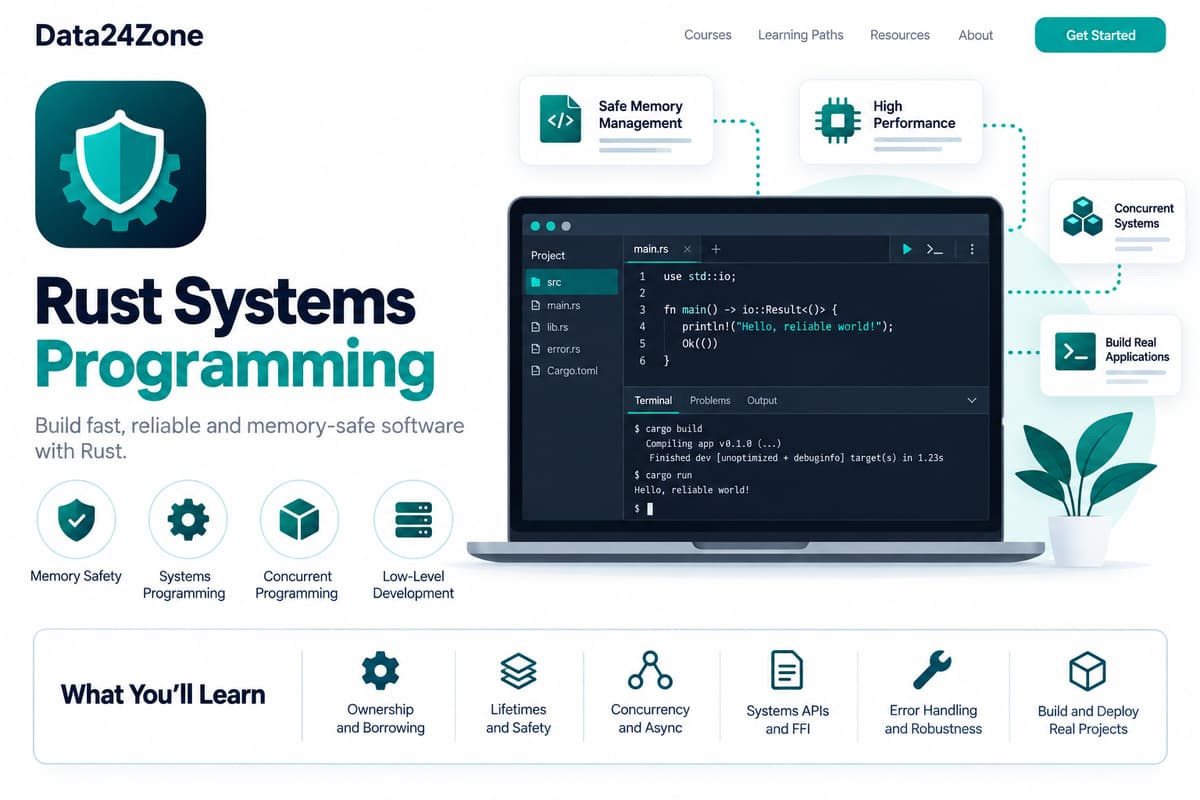
Rust Systems Programming is an 8-week intermediate course covering ownership, borrowing, structs, enums, traits, lifetimes, and fearless concurrency for building reliable command-line tools. Learners with prior programming experience practice with Cargo and external crates, culminating in a multithreaded file-processing CLI and a concurrent log summarizer with explicit error types and tested parsing.
Use Rust ownership, borrowing and explicit errors to build a reliable command-line tool.
What you'll learn
Course details
Duration
8 weeks
Best for
Learners who already have: Programming experience with types, functions and collections.
Enrollment isn't open for this course yet — check back soon or contact us.
Course Curriculum
A module-by-module breakdown of what you'll cover in Rust Systems Programming.
01Basic
4 topicsWeeks 1–2
- What is Rust, and what problem does it solve?
- Ownership: Rust's core idea
- Borrowing: using data without taking ownership
- Project: Build a word counter using ownership and borrowing
02Intermediate
4 topicsWeek 3
- Structs, enums, and pattern matching
- Error handling with Result and Option
- Traits: Rust's approach to shared behavior
- Project: Build a shape calculator with traits and error handling
03Advanced
4 topicsWeeks 4–5
- Turn a business request into a testable contract
- Use borrowing to make aliasing and lifetime rules explicit
- Represent ordinary failure with Result and Option
- Express reusable behavior through small trait contracts
04Pro
4 topicsWeek 6
- Lifetimes: ensuring references are always valid
- Fearless concurrency: threads without data races
- Building CLI tools with Cargo and external crates
- Project: Build a multithreaded file-processing CLI tool
05AI Pro
3 topicsWeeks 7–8
- Using Claude, ChatGPT, and Perplexity to understand Rust's compiler errors
- Verifying you understand the rule, not just the fix
- Project: Learn a borrow-checker rule with AI, then construct your own example
Tools & Technologies
Hands-on practice with the same tools used by working professionals.
Real-Time, Industry-Based Projects
This is project-based learning modeled on real industry scenarios — you'll build portfolio-ready work as you go, not just watch lectures.
Every course includes a guided internship on top of your project work — so you graduate with real experience, not just a certificate.
Communication & Soft Skills
Built into every course, alongside the technical curriculum.
Communication Skills
Practice explaining technical work clearly to teammates, managers, and clients.
Practical AI Skills
Hands-on training in using AI tools well — prompting, everyday workflows, and where AI actually helps versus where it doesn't.
Teamwork & Collaboration
Work in small project teams using real workflows like stand-ups and code reviews.
Problem Solving
Build the habit of breaking down ambiguous problems into clear, solvable steps.
Time Management
Learn to plan, prioritize, and deliver project work against realistic deadlines.
Presentation Skills
Present your project work and results with confidence, as you would to a client.
Resume & Profile Building
Build a strong resume, LinkedIn profile, and project portfolio that recruiters notice.
Interview Preparation
Mock interviews and portfolio reviews to get you ready for real job applications.
Career & Placement Support
100% of students enrolled in Rust Systems Programming get full access to placement support — real tools and guidance, not just a promise. This is support and access, not a guaranteed job outcome.
Resume Builder
A resume auto-built from your real completed projects and certificates, ready to export.
Shareable Portfolio
A public portfolio page showcasing your approved projects, with a link you can share with employers.
Interview Preparation
Guidance on presenting your projects and experience clearly in real interviews.
Peer & Mentor Community
Ongoing access to our learner community for questions, feedback, and support after you finish.
What Your Certificates Look Like
Real, verifiable certificates with your name, Rust Systems Programming, and a QR code anyone can scan to confirm they're genuine — one for completing the course, and a separate one if you take the internship track. Earning a certificate is free. To view, download and share it, there's a one-time ₹100 release fee per certificate — the same for free-course, paid-course and internship certificates.
Course Completion Certificate

 Data24Zone
Certificate of Completion
Illustrative recipient
Your Name Here
Example certificate for completion of
Rust Systems Programming
- Certificate No.
- D24-SAMPLE
- Mode
- Self-Paced
- Duration
- 8 weeks
- Example issue date
- On completion
Sample only — not a real, issued certificate.
Verification is available only on issued certificates.
Internship Completion Certificate
Data24ZoneCertificate of Internship
Illustrative recipient
Your Name Here
Example certificate for completion of
Rust Systems Programming
- Certificate No.
- D24-SAMPLE
- Mode
- Internship
- Duration
- 8 weeks
- Example issue date
- On completion
Sample only — not a real, issued certificate.
Verification is available only on issued certificates.
Frequently Asked Questions
What will I learn in the Rust Systems Programming course?
You'll learn: Turn a business request into a testable contract; Use borrowing to make aliasing and lifetime rules explicit; Represent ordinary failure with Result and Option; Express reusable behavior through small trait contracts.
What tools and technologies does the Rust Systems Programming course cover?
This course covers: Rust, Cargo, ChatGPT, Claude, Perplexity.
Is the Rust Systems Programming course beginner-friendly?
This is a intermediate-level course, so it assumes some prior familiarity with the subject.
How long does the Rust Systems Programming course take to complete?
The course is designed to be completed in approximately 8 weeks, depending on your pace.
What enrollment options are available for Rust Systems Programming?
Project Training Track (₹1,499) — One defined learning project and 2 review sessions; no employment or stipend included. Self-Paced (₹1,999) — Learn anytime with the full recorded curriculum and community access.
Is there an internship option for Rust Systems Programming?
Yes — the Internship track means working through real projects with our team and earning a separate Internship Certificate.
Will I get a certificate after completing Rust Systems Programming?
Yes. Self-paced enrollment earns a course completion certificate once your final project is reviewed and approved. Internship enrollment earns an internship certificate once your internship projects are approved. Every certificate is publicly verifiable on our website and can be added directly to your LinkedIn profile. Earning it is free; releasing it to view, download and share is a one-time ₹100 fee per certificate.
What kind of projects will I build in Rust Systems Programming?
You'll work on real projects such as: Concurrent-ready log summarizer with explicit error types and tested parsing.
Is placement support included with Rust Systems Programming?
Yes — every enrolled student gets full access to our placement support: resume building, a shareable project portfolio, mock interview preparation, and guidance applying what you've built to real job applications. This is support and access, not a guaranteed job outcome — how quickly it leads to an offer depends on the market and your own effort.