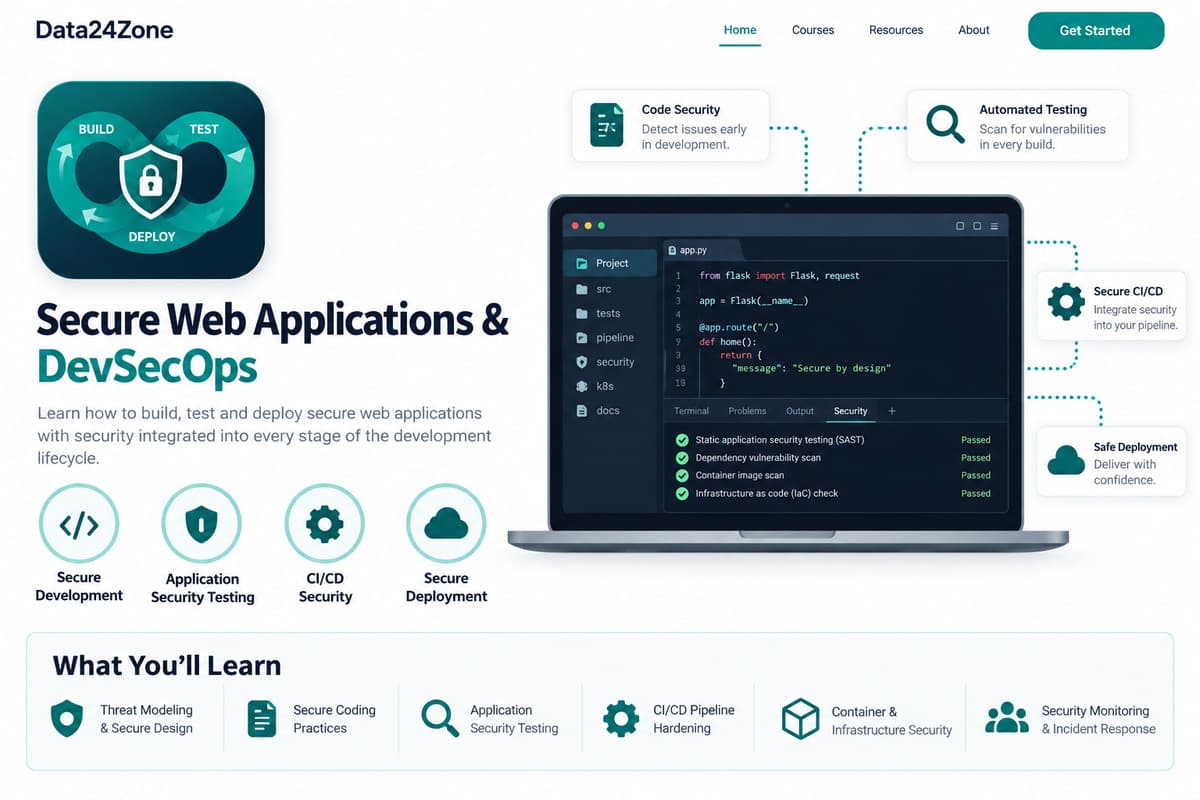
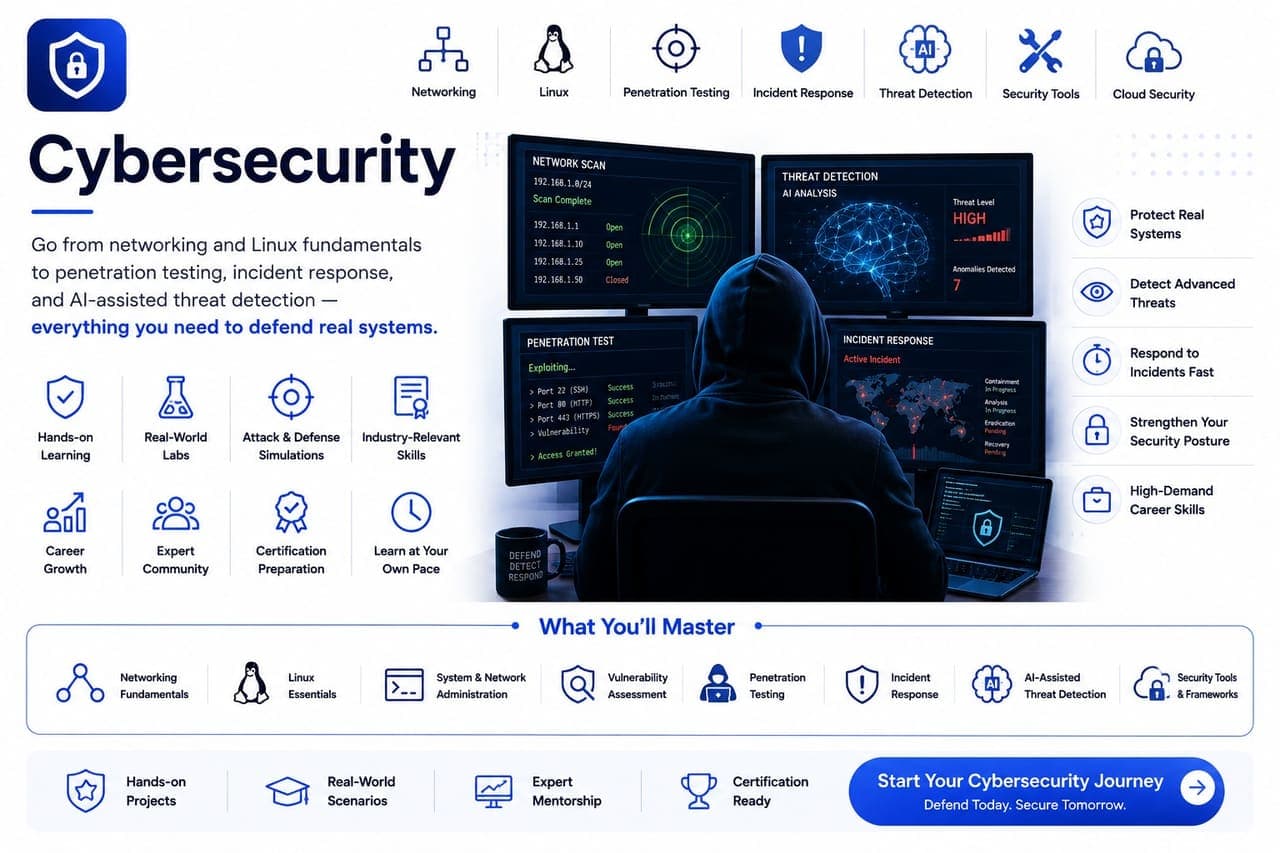
Cybersecurity Foundations
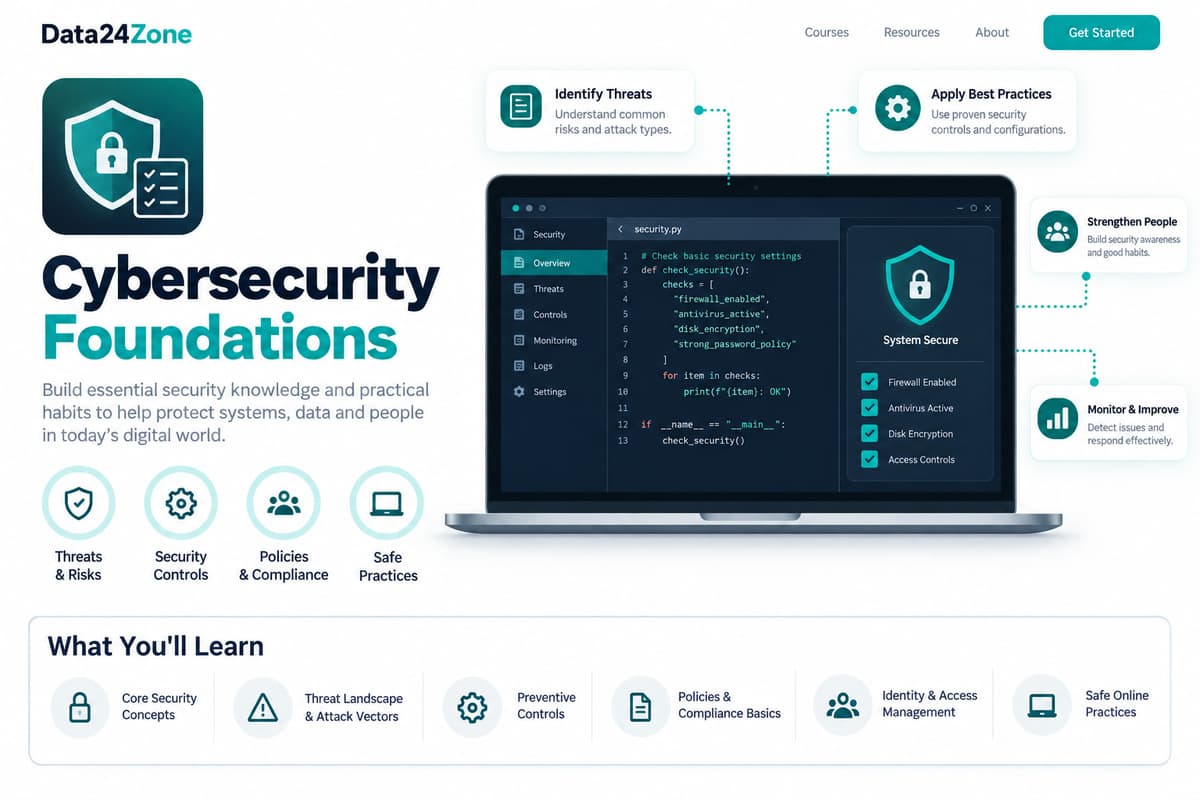
Cybersecurity Foundations is a beginner course covering core security concepts for protecting systems and data. Over 3 weeks, learners identify assets and risks, distinguish authentication from authorization, and respond to a suspicious message or incident, then progress to network security, encryption, access control models, incident response, and compliance frameworks — suited to anyone new to cybersecurity.
Identify assets and risks. Distinguish authentication and authorization. Respond to a suspicious message or incident.
What you'll learn
Course details
Duration
3 weeks
Best for
Anyone new to Cybersecurity Foundations
This course is free
Course Curriculum
A module-by-module breakdown of what you'll cover in Cybersecurity Foundations.
01Basic
6 topicsWeek 1
- The CIA Triad: Confidentiality, Integrity, and Availability
- Common Attack Types: Phishing, Malware, and Social Engineering
- Authentication Fundamentals: Passwords, MFA, and Password Managers
- Safe Browsing: Spotting Malicious Websites and Downloads
- Physical Security and Social Engineering Beyond Phishing
- Project: Personal Security Audit and Incident Classification
02Intermediate
6 topicsWeek 2
- Network Security Basics: Firewalls, VPNs, and Segmentation
- Encryption Fundamentals: Symmetric, Asymmetric, and Hashing
- Access Control Models: The Principle of Least Privilege, RBAC, and Zero Trust
- Wireless and Home Network Security
- Cloud Security Basics: The Shared Responsibility Model
- Project: Design a Network Security and Access Control Plan
03Advanced
8 topicsWeek 2
- Assets, threats and controls
- Identity and least privilege
- Phishing and incident basics
- Data minimization reduces exposure
- Access reviews and account removal
- Practice an incident tabletop
- Introduction to Web Application Security: The OWASP Top 10 at a Glance
- Building a Security-Aware Culture
04Pro
6 topicsWeek 3
- Incident Response Fundamentals: The Six-Phase Lifecycle
- Security Compliance Frameworks: SOC 2, ISO 27001, and GDPR
- Vulnerability Management: Scanning, Prioritization, and Patching
- Penetration Testing Methodology: How Ethical Hackers Assess Systems
- Data Backup, Recovery, and Business Continuity Basics
- Project: Build an Incident Response Plan and Vulnerability Prioritization Framework
05AI Pro
3 topicsWeek 3
- Using Claude, ChatGPT, and Perplexity to Analyze Threats and Draft Security Policies
- Verifying AI-Assisted Security Analysis and Policy Drafts Before Trusting Them
- Project: AI-Assisted Threat Analysis and Policy Drafting with Independent Verification
Communication & Soft Skills
Built into every course, alongside the technical curriculum.
Communication Skills
Practice explaining technical work clearly to teammates, managers, and clients.
Practical AI Skills
Hands-on training in using AI tools well — prompting, everyday workflows, and where AI actually helps versus where it doesn't.
Teamwork & Collaboration
Work in small project teams using real workflows like stand-ups and code reviews.
Problem Solving
Build the habit of breaking down ambiguous problems into clear, solvable steps.
Time Management
Learn to plan, prioritize, and deliver project work against realistic deadlines.
Presentation Skills
Present your project work and results with confidence, as you would to a client.
Resume & Profile Building
Build a strong resume, LinkedIn profile, and project portfolio that recruiters notice.
Interview Preparation
Mock interviews and portfolio reviews to get you ready for real job applications.
Career & Placement Support
100% of students enrolled in Cybersecurity Foundations get full access to placement support — real tools and guidance, not just a promise. This is support and access, not a guaranteed job outcome.
Resume Builder
A resume auto-built from your real completed projects and certificates, ready to export.
Shareable Portfolio
A public portfolio page showcasing your approved projects, with a link you can share with employers.
Interview Preparation
Guidance on presenting your projects and experience clearly in real interviews.
Peer & Mentor Community
Ongoing access to our learner community for questions, feedback, and support after you finish.
What Your Certificates Look Like
Real, verifiable certificates with your name, Cybersecurity Foundations, and a QR code anyone can scan to confirm they're genuine — one for completing the course, and a separate one if you take the internship track. Earning a certificate is free. To view, download and share it, there's a one-time ₹100 release fee per certificate — the same for free-course, paid-course and internship certificates.
Course Completion Certificate

 Data24Zone
Certificate of Completion · Free Course
Illustrative recipient
Your Name Here
Example certificate for completion of
Cybersecurity Foundations
- Certificate No.
- D24-SAMPLE
- Mode
- Self-Paced
- Duration
- 3 weeks
- Example issue date
- On completion
Sample only — not a real, issued certificate.
Verification is available only on issued certificates.
Internship Completion Certificate
Data24ZoneCertificate of Internship
Illustrative recipient
Your Name Here
Example certificate for completion of
Cybersecurity Foundations
- Certificate No.
- D24-SAMPLE
- Mode
- Internship
- Duration
- 3 weeks
- Example issue date
- On completion
Sample only — not a real, issued certificate.
Verification is available only on issued certificates.
Frequently Asked Questions
What will I learn in the Cybersecurity Foundations course?
You'll learn: Identify assets and risks.; Distinguish authentication and authorization.; Respond to a suspicious message or incident..
Is the Cybersecurity Foundations course beginner-friendly?
Yes — this is a beginner-level course.
How long does the Cybersecurity Foundations course take to complete?
The course is designed to be completed in approximately 3 weeks, depending on your pace.
What enrollment options are available for Cybersecurity Foundations?
Project Training Track (₹1,499) — One defined learning project and 2 review sessions; no employment or stipend included. Self-Paced (₹1,999) — Learn anytime with the full recorded curriculum and community access.
Is there an internship option for Cybersecurity Foundations?
Yes — the Internship track means working through real projects with our team and earning a separate Internship Certificate.
Will I get a certificate after completing Cybersecurity Foundations?
Yes. Self-paced enrollment earns a course completion certificate once your final project is reviewed and approved. Internship enrollment earns an internship certificate once your internship projects are approved. Every certificate is publicly verifiable on our website and can be added directly to your LinkedIn profile. Earning it is free; releasing it to view, download and share is a one-time ₹100 fee per certificate.
Is placement support included with Cybersecurity Foundations?
Yes — every enrolled student gets full access to our placement support: resume building, a shareable project portfolio, mock interview preparation, and guidance applying what you've built to real job applications. This is support and access, not a guaranteed job outcome — how quickly it leads to an offer depends on the market and your own effort.