Natural Language Processing
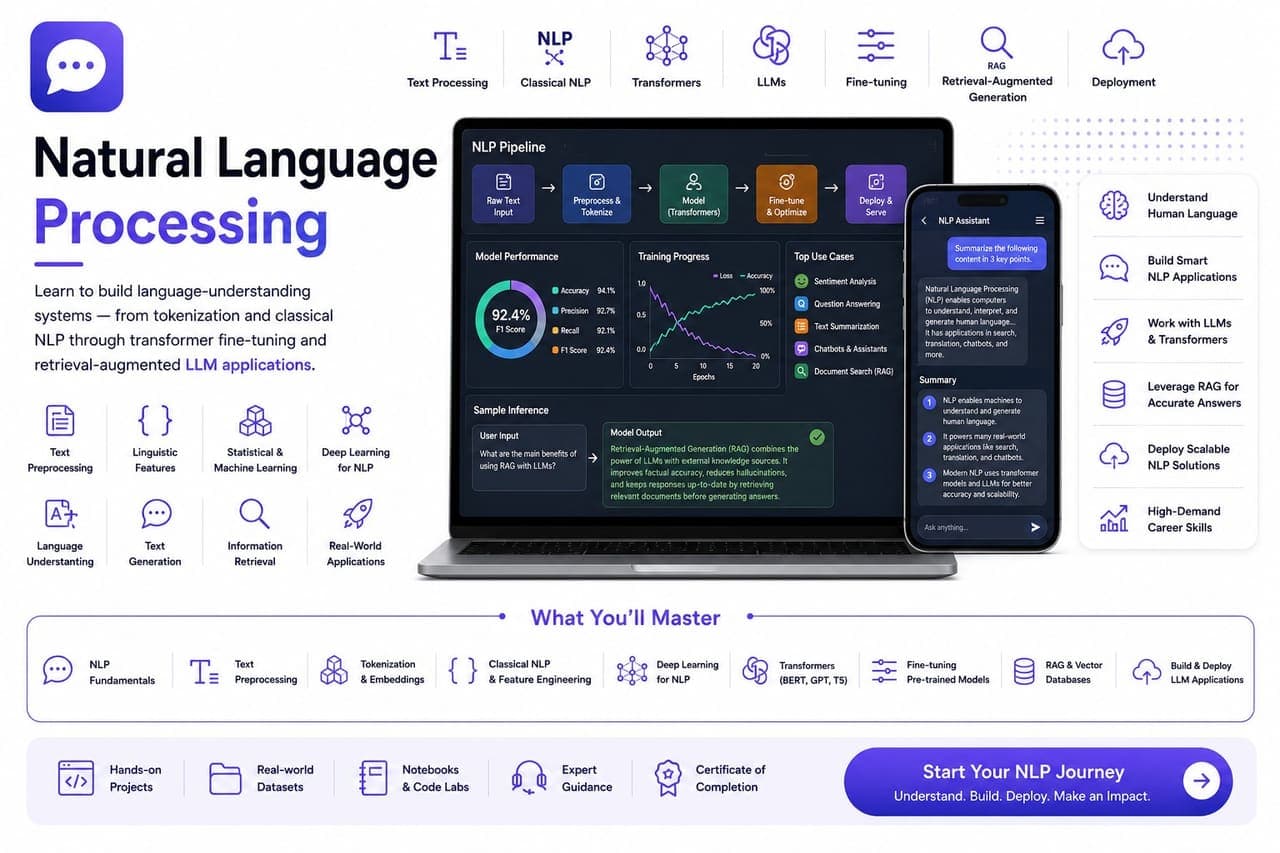
Natural Language Processing is a 10-week course teaching you to build language-understanding systems, from tokenization, POS tagging, and classical methods like TF-IDF through fine-tuning transformer models (BERT, GPT) with Hugging Face, and building retrieval-augmented LLM applications with vector search — for Python developers wanting to specialize in language-based AI.
Learn to build language-understanding systems — from tokenization and classical NLP through transformer fine-tuning and retrieval-augmented LLM applications.
What you'll learn
Course details
Duration
10 weeks
Best for
Developers with Python experience who want to specialize in building language-based AI systems
Enrollment isn't open for this course yet — check back soon or contact us.
Course Curriculum
A module-by-module breakdown of what you'll cover in Natural Language Processing.
01Getting Started & Environment Setup
4 topicsWeeks 1–2
- Installing Python, spaCy, and NLTK
- Installing PyTorch and Hugging Face Transformers
- Creating a free Pinecone account (or setting up FAISS locally)
- Verifying your setup by loading a spaCy model and processing a test sentence
02Basic
4 topicsWeek 3
- String handling, regex, and Unicode normalization
- Word and subword tokenization
- POS tagging and named entity recognition
- Dependency and constituency parsing with spaCy
03Intermediate
4 topicsWeeks 4–5
- Bag-of-words, n-grams, and TF-IDF
- word2vec and GloVe embeddings
- Cosine similarity for document comparison
- Building and comparing document classifiers
04Advanced
4 topicsWeeks 6–7
- RNN and LSTM fundamentals
- Sequence labeling and seq2seq architectures
- BLEU, ROUGE, and span-level evaluation metrics
- Confusion matrices and error analysis
05Pro
7 topicsWeek 8
- Self-attention and positional encoding
- BERT and GPT-family architectures
- Fine-tuning for classification, NER, and QA with Hugging Face
- WordPiece and BPE tokenizers
- Prompt engineering and few-shot prompting
- Embeddings, semantic search, and retrieval-augmented generation
- Serving NLP models with FastAPI and Docker
06AI Pro
3 topicsWeeks 9–10
- Using Claude, ChatGPT, and Perplexity for NLP data labeling and prototyping
- Verifying AI-generated labels and NLP pipeline suggestions
- Project: Use AI to pre-label a dataset, then audit for systematic bias
Tools & Technologies
Hands-on practice with the same tools used by working professionals.
Real-Time, Industry-Based Projects
This is project-based learning modeled on real industry scenarios — you'll build portfolio-ready work as you go, not just watch lectures.
Every course includes a guided internship on top of your project work — so you graduate with real experience, not just a certificate.
Communication & Soft Skills
Built into every course, alongside the technical curriculum.
Communication Skills
Practice explaining technical work clearly to teammates, managers, and clients.
Practical AI Skills
Hands-on training in using AI tools well — prompting, everyday workflows, and where AI actually helps versus where it doesn't.
Teamwork & Collaboration
Work in small project teams using real workflows like stand-ups and code reviews.
Problem Solving
Build the habit of breaking down ambiguous problems into clear, solvable steps.
Time Management
Learn to plan, prioritize, and deliver project work against realistic deadlines.
Presentation Skills
Present your project work and results with confidence, as you would to a client.
Resume & Profile Building
Build a strong resume, LinkedIn profile, and project portfolio that recruiters notice.
Interview Preparation
Mock interviews and portfolio reviews to get you ready for real job applications.
Career & Placement Support
100% of students enrolled in Natural Language Processing get full access to placement support — real tools and guidance, not just a promise. This is support and access, not a guaranteed job outcome.
Resume Builder
A resume auto-built from your real completed projects and certificates, ready to export.
Shareable Portfolio
A public portfolio page showcasing your approved projects, with a link you can share with employers.
Interview Preparation
Guidance on presenting your projects and experience clearly in real interviews.
Peer & Mentor Community
Ongoing access to our learner community for questions, feedback, and support after you finish.
What Your Certificates Look Like
Real, verifiable certificates with your name, Natural Language Processing, and a QR code anyone can scan to confirm they're genuine — one for completing the course, and a separate one if you take the internship track. Earning a certificate is free. To view, download and share it, there's a one-time ₹100 release fee per certificate — the same for free-course, paid-course and internship certificates.
Course Completion Certificate

 Data24Zone
Certificate of Completion
Illustrative recipient
Your Name Here
Example certificate for completion of
Natural Language Processing
- Certificate No.
- D24-SAMPLE
- Mode
- Self-Paced
- Duration
- 10 weeks
- Example issue date
- On completion
Sample only — not a real, issued certificate.
Verification is available only on issued certificates.
Internship Completion Certificate
Data24ZoneCertificate of Internship
Illustrative recipient
Your Name Here
Example certificate for completion of
Natural Language Processing
- Certificate No.
- D24-SAMPLE
- Mode
- Internship
- Duration
- 10 weeks
- Example issue date
- On completion
Sample only — not a real, issued certificate.
Verification is available only on issued certificates.
Frequently Asked Questions
What will I learn in the Natural Language Processing course?
You'll learn: Text preprocessing, tokenization, and core linguistics techniques like POS tagging and NER; Classical NLP methods including TF-IDF, word embeddings, and sequence models; Fine-tuning transformer models with Hugging Face for classification, NER, and QA; Building and deploying retrieval-augmented LLM applications with vector search.
What tools and technologies does the Natural Language Processing course cover?
This course covers: Python, spaCy / NLTK, Hugging Face Transformers, PyTorch, LangChain, Vector databases (Pinecone / FAISS), FastAPI, Weights & Biases, ChatGPT, Claude, Perplexity.
Is the Natural Language Processing course beginner-friendly?
This is a intermediate-level course, so it assumes some prior familiarity with the subject. It starts with a "Getting Started & Environment Setup" module covering tool installation before the main curriculum.
How long does the Natural Language Processing course take to complete?
The course is designed to be completed in approximately 10 weeks, depending on your pace.
What enrollment options are available for Natural Language Processing?
Project Training Track (₹1,499) — One defined learning project and 2 review sessions; no employment or stipend included. Self-Paced (₹1,999) — Learn anytime with the full recorded curriculum and community access.
Is there an internship option for Natural Language Processing?
Yes — the Internship track means working through real projects with our team and earning a separate Internship Certificate.
Will I get a certificate after completing Natural Language Processing?
Yes. Self-paced enrollment earns a course completion certificate once your final project is reviewed and approved. Internship enrollment earns an internship certificate once your internship projects are approved. Every certificate is publicly verifiable on our website and can be added directly to your LinkedIn profile. Earning it is free; releasing it to view, download and share is a one-time ₹100 fee per certificate.
What kind of projects will I build in Natural Language Processing?
You'll work on real projects such as: Resume and invoice information extraction using rule-based and statistical NER to pull structured fields from documents; Support ticket triage and sentiment classifier comparing a TF-IDF baseline against a fine-tuned DistilBERT model; Abstractive text summarization service fine-tuned on a domain-specific corpus and evaluated with ROUGE; Semantic search and RAG assistant that answers questions over a custom document set with citations; Production NLP API serving a fine-tuned classification model with monitoring and drift detection.
Is placement support included with Natural Language Processing?
Yes — every enrolled student gets full access to our placement support: resume building, a shareable project portfolio, mock interview preparation, and guidance applying what you've built to real job applications. This is support and access, not a guaranteed job outcome — how quickly it leads to an offer depends on the market and your own effort.