Industry Automation
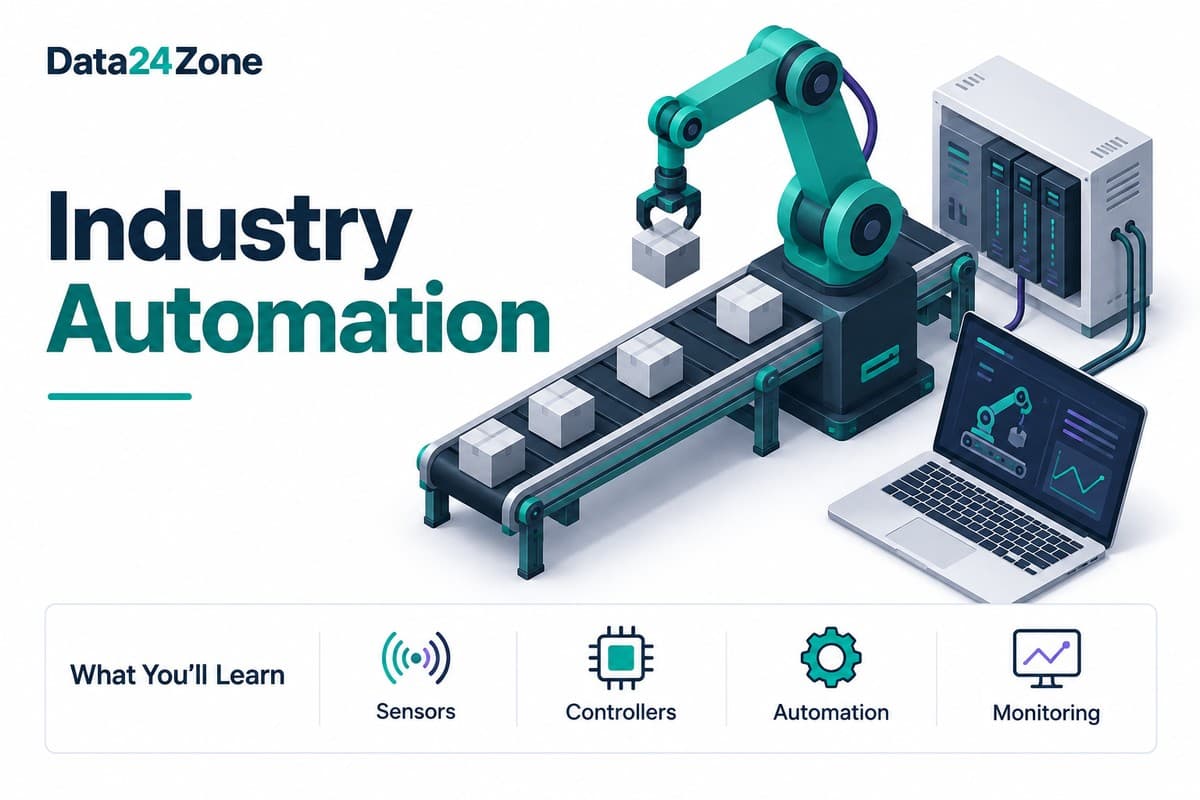
Industry Automation is a 10-week course teaching how real factories and production lines are automated — PLC programming with ladder logic and structured text, industrial sensors, actuators, safety interlocks, SCADA systems, industrial protocols, and PID control — through to commissioning a real system, for beginners entering industrial or manufacturing automation careers.
Learn how real factories and production lines are automated — PLCs, ladder logic, SCADA, and industrial safety — from the ground up to production-scale systems.
What you'll learn
Course details
Duration
10 weeks
Best for
Beginners interested in industrial, electrical, or manufacturing automation careers
Enrollment isn't open for this course yet — check back soon or contact us.
Course Curriculum
A module-by-module breakdown of what you'll cover in Industry Automation.
01Getting Started & Environment Setup
4 topicsWeeks 1–2
- Installing a free PLC simulator (e.g. Open PLC or a vendor trial)
- Understanding a typical industrial automation lab safety briefing
- Touring a simple simulated control panel
- Running your first simulated ladder logic program
02Basic
7 topicsWeek 3
- What is industrial automation, and why factories automate
- Relay logic and ladder diagram basics
- Digital vs. analog I/O in industrial systems
- Introduction to PLCs (Programmable Logic Controllers)
- Basic ladder logic programming
- Timers and counters in ladder logic
- Project: simulate a conveyor belt start/stop circuit
03Intermediate
7 topicsWeeks 4–5
- PLC programming languages: ladder, function block, structured text
- Sensors used in industrial automation
- Actuators: motors, solenoids, and pneumatic cylinders
- Sequential control and state machines
- Interlocks and safety circuits
- Introduction to HMI (Human-Machine Interfaces)
- Project: automated sorting system simulation
04Advanced
7 topicsWeeks 6–7
- Industrial communication protocols (Modbus and others)
- SCADA systems explained
- PID control basics
- Variable frequency drives and motor control
- Data logging and historian basics
- Fault diagnosis and troubleshooting automated systems
- Project: design a small automated production line
05Pro
6 topicsWeek 8
- Industrial safety standards and risk assessment
- Redundancy and high-availability automation systems
- Integrating IoT with industrial automation (IIoT)
- Predictive maintenance basics
- Documentation and commissioning an automation project
- Project: commission and document a complete automated system
06AI Pro
4 topicsWeeks 9–10
- Using Claude, ChatGPT, and Perplexity for automation troubleshooting
- Prompting for ladder logic and structured text review
- Verifying AI suggestions on safety-critical systems
- Project: AI-assisted automation troubleshooting workflow
Tools & Technologies
Hands-on practice with the same tools used by working professionals.
Real-Time, Industry-Based Projects
This is project-based learning modeled on real industry scenarios — you'll build portfolio-ready work as you go, not just watch lectures.
Every course includes a guided internship on top of your project work — so you graduate with real experience, not just a certificate.
Communication & Soft Skills
Built into every course, alongside the technical curriculum.
Communication Skills
Practice explaining technical work clearly to teammates, managers, and clients.
Practical AI Skills
Hands-on training in using AI tools well — prompting, everyday workflows, and where AI actually helps versus where it doesn't.
Teamwork & Collaboration
Work in small project teams using real workflows like stand-ups and code reviews.
Problem Solving
Build the habit of breaking down ambiguous problems into clear, solvable steps.
Time Management
Learn to plan, prioritize, and deliver project work against realistic deadlines.
Presentation Skills
Present your project work and results with confidence, as you would to a client.
Resume & Profile Building
Build a strong resume, LinkedIn profile, and project portfolio that recruiters notice.
Interview Preparation
Mock interviews and portfolio reviews to get you ready for real job applications.
Career & Placement Support
100% of students enrolled in Industry Automation get full access to placement support — real tools and guidance, not just a promise. This is support and access, not a guaranteed job outcome.
Resume Builder
A resume auto-built from your real completed projects and certificates, ready to export.
Shareable Portfolio
A public portfolio page showcasing your approved projects, with a link you can share with employers.
Interview Preparation
Guidance on presenting your projects and experience clearly in real interviews.
Peer & Mentor Community
Ongoing access to our learner community for questions, feedback, and support after you finish.
What Your Certificates Look Like
Real, verifiable certificates with your name, Industry Automation, and a QR code anyone can scan to confirm they're genuine — one for completing the course, and a separate one if you take the internship track. Earning a certificate is free. To view, download and share it, there's a one-time ₹100 release fee per certificate — the same for free-course, paid-course and internship certificates.
Course Completion Certificate

 Data24Zone
Certificate of Completion
Illustrative recipient
Your Name Here
Example certificate for completion of
Industry Automation
- Certificate No.
- D24-SAMPLE
- Mode
- Self-Paced
- Duration
- 10 weeks
- Example issue date
- On completion
Sample only — not a real, issued certificate.
Verification is available only on issued certificates.
Internship Completion Certificate
Data24ZoneCertificate of Internship
Illustrative recipient
Your Name Here
Example certificate for completion of
Industry Automation
- Certificate No.
- D24-SAMPLE
- Mode
- Internship
- Duration
- 10 weeks
- Example issue date
- On completion
Sample only — not a real, issued certificate.
Verification is available only on issued certificates.
Frequently Asked Questions
What will I learn in the Industry Automation course?
You'll learn: PLC programming with ladder logic and structured text; Industrial sensors, actuators, and safety interlocks; SCADA systems, industrial protocols, and PID control; Commissioning and documenting a real automated system.
What tools and technologies does the Industry Automation course cover?
This course covers: PLC simulator, Ladder Logic, SCADA, Modbus, HMI.
Is the Industry Automation course beginner-friendly?
Yes — this is a beginner-level course. It starts with a "Getting Started & Environment Setup" module covering tool installation before the main curriculum.
How long does the Industry Automation course take to complete?
The course is designed to be completed in approximately 10 weeks, depending on your pace.
What enrollment options are available for Industry Automation?
Live Class (₹6,999) — Instructor-led live cohort with doubt-clearing sessions — earns both the course and internship certificates (₹100 release fee each). Recorded Batch (₹3,999) — Full recordings of a completed live batch — earns both the course and internship certificates (₹100 release fee each). Project Training Track (₹1,499) — One defined learning project and 2 review sessions; no employment or stipend included. Self-Paced (₹1,999) — Learn anytime with the full recorded curriculum and community access.
Is there an internship option for Industry Automation?
Yes — enrolling in the Internship track (or the Live/Recorded tracks, which include it) means working through real projects with our team and earning a separate Internship Certificate, in addition to the course completion certificate for Live/Recorded enrollments.
Will I get a certificate after completing Industry Automation?
Yes. Self-paced enrollment earns a course completion certificate once your final project is reviewed and approved. Internship enrollment earns an internship certificate once your internship projects are approved. Live and Recorded enrollments earn both. Every certificate is publicly verifiable on our website and can be added directly to your LinkedIn profile. Earning it is free; releasing it to view, download and share is a one-time ₹100 fee per certificate.
What kind of projects will I build in Industry Automation?
You'll work on real projects such as: Simulated conveyor belt start/stop circuit; Automated sorting system simulation; Small automated production line design; Commissioned and documented automated system.
Is placement support included with Industry Automation?
Yes — every enrolled student gets full access to our placement support: resume building, a shareable project portfolio, mock interview preparation, and guidance applying what you've built to real job applications. This is support and access, not a guaranteed job outcome — how quickly it leads to an offer depends on the market and your own effort.