Data Science 360: Analytics, ML & AI
Data Science 360 is a 20-week program for learners who want the full data science path: Python and SQL, statistics and experiments, explainable machine learning, forecasting, deep learning with PyTorch, NLP and RAG, and deploying models with FastAPI, Docker and MLflow — all built for one digital lending company, ending in a deployed capstone.
The deep data science path — statistics, machine learning, deep learning, NLP and generative AI — building and deploying models for one lending company, not just studying them.
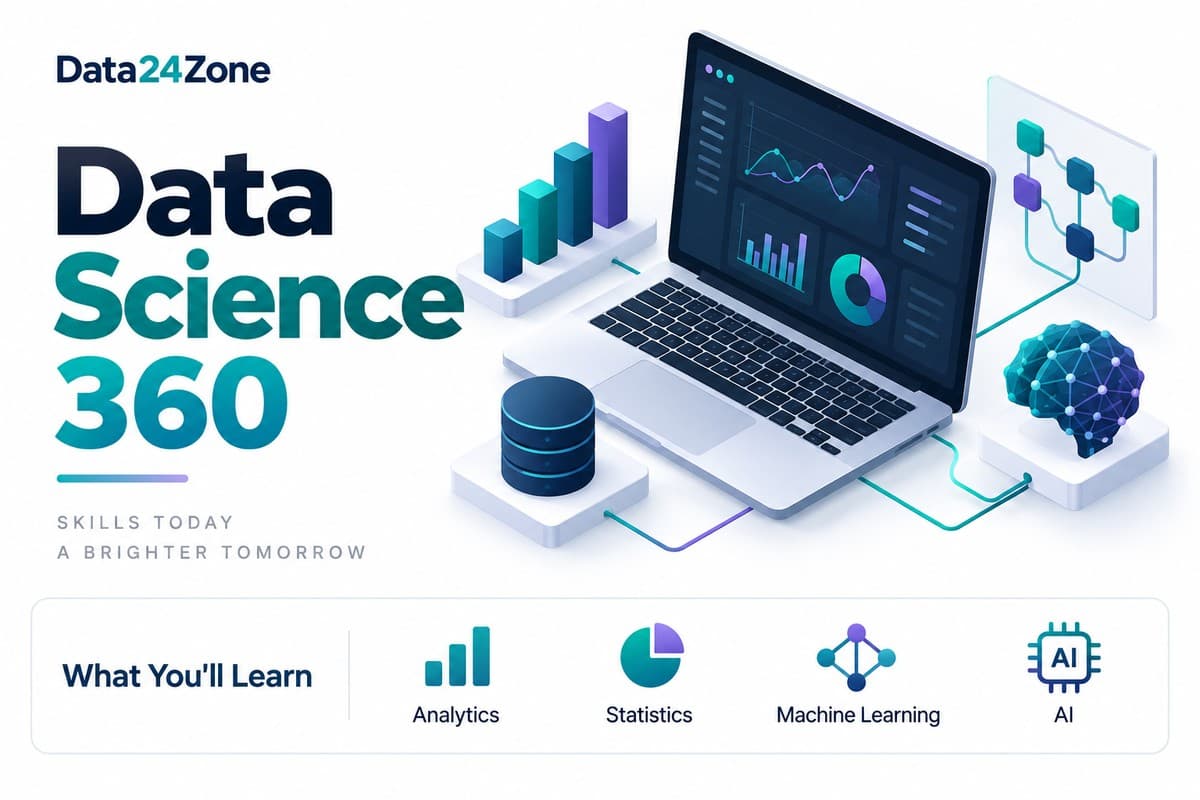
What you'll learn
Course details
Duration
20 weeks
Best for
Learners who want one structured path spanning data analysis, machine learning, and generative/agentic AI
Enrollment isn't open for this course yet — check back soon or contact us.
Course Curriculum
A module-by-module breakdown of what you'll cover in Data Science 360: Analytics, ML & AI.
01Week 0: How data scientists work: framing, setup and GitHub
5 topicsWeeks 1–2
- DS lifecycle: business problem → metric → data → model → decision → monitoring
- Lending basics: default, loss given default, approval rate, unit economics
- Framing a prediction problem and choosing a success metric
- Reproducible environments and version control
- Portfolio: GitHub repo with project template and a one-page problem-framing doc
02Weeks 1–3: Python, SQL and EDA fast-track on lending data
7 topicsWeeks 3–4
- Python for data work: functions, comprehensions, modules, error handling, small tests
- NumPy arrays and vectorisation
- pandas: cleaning, merging multi-table data, groupby, reshaping
- Analytical SQL: joins, CTEs, window functions for feature building
- EDA and visualisation; missing-data patterns
- Data quality and leakage checks
- Portfolio: Data audit + EDA notebook and a tested feature-building module (SQL + Python) in the repo
03Weeks 4–5: Statistics, experiments and regression for decisions
7 topicsWeeks 5–6
- Probability and distributions in context (defaults as Bernoulli, losses as skewed)
- Sampling, bootstrap and confidence intervals
- Hypothesis testing, power, multiple testing
- A/B test design for a loan-offer experiment; guardrail metrics
- Linear and logistic regression with the linear algebra behind them (vectors, matrices, least squares)
- Correlation vs causation; confounding and simple causal diagrams
- Portfolio: Experiment readout + interpretable regression notebook with a written decision memo
04Week 6: Communicating data: a risk portfolio dashboard
5 topicsWeeks 7–8
- Choosing charts for risk and portfolio metrics
- Data modelling basics for BI (star schema, measures)
- Storytelling for credit and business teams
- Python-native dashboards vs BI tools
- Portfolio: Published portfolio-risk dashboard (Power BI or Streamlit) + one-page credit committee summary
05Weeks 7–9: Machine learning: a credit default model you can explain
7 topicsWeeks 9–10
- ML workflow and scikit-learn pipelines; train/validation/test and time-based splits
- Gradient descent and loss functions (calculus woven in)
- Logistic regression, decision trees, random forests, gradient boosting
- Imbalanced data: class weights, PR-AUC, threshold choice by business cost
- Cross-validation, hyperparameter tuning, probability calibration
- Explainability (SHAP), fairness checks and model cards
- Portfolio: Credit-default model repo: pipeline code, MLflow experiment log, model card with explanations and fairness results
06Weeks 10–11: Advanced ML: segmentation, anomalies and forecasting
6 topicsWeeks 11–12
- Feature engineering and selection
- Clustering (k-means, hierarchical) and PCA for borrower segments
- Anomaly detection (Isolation Forest) for suspicious applications
- Time-series forecasting: trend, seasonality, backtesting; statsmodels and Prophet-style models
- Survival analysis intro: time-to-default
- Portfolio: Segmentation + collections-forecast notebook with a short business memo
07Weeks 12–13: Deep learning: neural networks for tabular data and documents
6 topicsWeeks 13–14
- Neurons, activations, backpropagation (calculus recap in code)
- PyTorch training loop, batching, regularisation, early stopping
- Embeddings for categorical features
- CNNs and transfer learning with pretrained models
- When deep learning is not worth it versus boosted trees
- Portfolio: Deep-learning repo: tabular-NN vs boosting comparison + document-image classifier with error analysis
08Weeks 14–15: NLP and GenAI: complaint triage and a RAG policy assistant
7 topicsWeeks 15–16
- Text cleaning, TF-IDF and a classical classifier
- Embeddings and transformers; Hugging Face pipelines
- LLM APIs, prompting and structured (JSON) output
- Retrieval-augmented generation: chunking, vector search, citations
- Evaluating LLM output: labelled test sets, groundedness, cost and latency
- Responsible GenAI: PII, hallucination, prompt injection
- Portfolio: Complaint-triage pipeline (classical vs LLM comparison) + RAG policy assistant with an evaluation report
09Weeks 16–17: Deployment and MLOps: ship the scoring service
7 topicsWeeks 17–18
- Packaging models; FastAPI inference endpoints with input validation
- Docker basics
- Experiment tracking and model registry with MLflow
- Data and prediction drift monitoring
- CI with GitHub Actions; basic tests for data and models
- Governance: versioning, audit trail, human review for declines
- Portfolio: Live loan-scoring demo app + API with drift report and CI badge
10Weeks 18–20: Capstones, portfolio and data scientist interview prep
6 topicsWeeks 19–20
- Scoping an end-to-end DS project with a business metric
- Combining analysis, ML and GenAI in one product
- Technical writing: README, model card, decision memo
- Demo videos and portfolio presentation
- DS interviews: ML theory, case studies, take-home tasks, coding rounds
- Portfolio: Two capstone repos with README, model card, live demo and 5-minute video; updated resume and LinkedIn
Tools & Technologies
Hands-on practice with the same tools used by working professionals.
Real-Time, Industry-Based Projects
This is project-based learning modeled on real industry scenarios — you'll build portfolio-ready work as you go, not just watch lectures.
Every course includes a guided internship on top of your project work — so you graduate with real experience, not just a certificate.
Communication & Soft Skills
Built into every course, alongside the technical curriculum.
Communication Skills
Practice explaining technical work clearly to teammates, managers, and clients.
Practical AI Skills
Hands-on training in using AI tools well — prompting, everyday workflows, and where AI actually helps versus where it doesn't.
Teamwork & Collaboration
Work in small project teams using real workflows like stand-ups and code reviews.
Problem Solving
Build the habit of breaking down ambiguous problems into clear, solvable steps.
Time Management
Learn to plan, prioritize, and deliver project work against realistic deadlines.
Presentation Skills
Present your project work and results with confidence, as you would to a client.
Resume & Profile Building
Build a strong resume, LinkedIn profile, and project portfolio that recruiters notice.
Interview Preparation
Mock interviews and portfolio reviews to get you ready for real job applications.
Career & Placement Support
Students enrolled in Data Science 360: Analytics, ML & AI get access to these placement-support tools and guidance. This is support and preparation, not a guaranteed job outcome.
Resume Builder
A resume auto-built from your real completed projects and certificates, ready to export.
Shareable Portfolio
A public portfolio page showcasing your approved projects, with a link you can share with employers.
Interview Preparation
Guidance on presenting your projects and experience clearly in real interviews.
Peer & Mentor Community
Ongoing access to our learner community for questions, feedback, and support after you finish.
What Your Certificates Look Like
Real, verifiable certificates with your name, Data Science 360: Analytics, ML & AI, and a QR code anyone can scan to confirm they're genuine — one for completing the course, and a separate one if you take the internship track. Certificates are included with Live and Recorded enrolments. For free courses, self-paced courses and internship tracks, earning a certificate is free and there's a one-time ₹100 fee to release it for viewing, download and sharing.
Course Completion Certificate

 Data24Zone
Certificate of Completion
Illustrative recipient
Your Name Here
Example certificate for completion of
Data Science 360: Analytics, ML & AI
- Certificate No.
- D24-SAMPLE
- Mode
- Self-Paced
- Duration
- 20 weeks
- Example issue date
- On completion
Sample only — not a real, issued certificate.
Verification is available only on issued certificates.
Internship Completion Certificate
Data24ZoneCertificate of Internship
Illustrative recipient
Your Name Here
Example certificate for completion of
Data Science 360: Analytics, ML & AI
- Certificate No.
- D24-SAMPLE
- Mode
- Internship
- Duration
- 20 weeks
- Example issue date
- On completion
Sample only — not a real, issued certificate.
Verification is available only on issued certificates.
Frequently Asked Questions
What is data science?
Data science uses statistics, programming, and machine learning to extract insight from data and build predictive models. It extends data analytics with modelling, deep learning, NLP, computer vision, and deploying models to production.
What is the difference between data analytics and data science?
Data analytics mainly describes and explains what happened using queries, reports, and dashboards. Data science adds prediction and automation — building machine learning models, evaluating them, and deploying them. Data Science 360 covers both, from statistics and SQL through ML, deep learning, and MLOps.
Do I need a math background for data science?
Working knowledge of algebra, statistics, and some linear algebra and calculus helps. The program includes a dedicated Mathematics for Data Science part covering these, so you do not need to arrive already knowing them.
What will I learn in the Data Science 360: Analytics, ML & AI course?
You'll learn: Statistics, experiments and regression on real business data; Explainable machine learning with fairness checks and model cards; Deep learning, NLP and retrieval-augmented generation (RAG); Deploying and monitoring models with FastAPI, Docker and MLflow.
What tools and technologies does the Data Science 360: Analytics, ML & AI course cover?
This course covers: Python (pandas, NumPy), SQL (DuckDB, PostgreSQL), scikit-learn, XGBoost/LightGBM, SHAP, statsmodels / SciPy, PyTorch, Hugging Face, Chroma / FAISS + LLM APIs, FastAPI, Streamlit, Docker, MLflow, Evidently, GitHub Actions, Power BI (one module), Claude / ChatGPT / Copilot.
Is the Data Science 360: Analytics, ML & AI course beginner-friendly?
This is a advanced-level course, so it assumes some prior familiarity with the subject.
How long does the Data Science 360: Analytics, ML & AI course take to complete?
The course is designed to be completed in approximately 20 weeks, depending on your pace.
What enrollment options are available for Data Science 360: Analytics, ML & AI?
Live Class (₹24,999) — Instructor-led live cohort with doubt-clearing sessions — earns both the course and internship certificates (included). Recorded Batch (₹12,999) — Full recordings of a completed live batch — earns both the course and internship certificates (included). Internship Track (₹2,999) — Defined project-based internship track; deliverables and review schedule confirmed before payment. Self-Paced (₹3,499) — Learn anytime with the full recorded curriculum and community access.
Is there an internship option for Data Science 360: Analytics, ML & AI?
Yes — enrolling in the Internship track (or the Live/Recorded tracks, which include it) means working through real projects with our team and earning a separate Internship Certificate, in addition to the course completion certificate for Live/Recorded enrollments.
Will I get a certificate after completing Data Science 360: Analytics, ML & AI?
Yes. Self-paced enrollment earns a course completion certificate once your final project is reviewed and approved. Internship enrollment earns an internship certificate once your internship projects are approved. Live and Recorded enrollments earn both. Every certificate is publicly verifiable on our website and can be added directly to your LinkedIn profile. Certificates are included with Live and Recorded enrollments; for other options, earning a certificate is free and releasing it to view, download and share is a one-time ₹100 fee per certificate.
What kind of projects will I build in Data Science 360: Analytics, ML & AI?
You'll work on real projects such as: Capstone: Explainable credit-risk decisioning service — KaasuFlow wants to raise approvals without raising losses; build a default model, pick a business-optimal cut-off and serve it with reason codes; Capstone: Customer-voice intelligence assistant — Leadership needs to know what borrowers complain about and to answer policy questions consistently; build complaint triage plus a cited RAG assistant; Data audit + EDA notebook and a tested feature-building module (SQL + Python) in the repo; Experiment readout + interpretable regression notebook with a written decision memo; Published portfolio-risk dashboard (Power BI or Streamlit) + one-page credit committee summary; Credit-default model repo: pipeline code, MLflow experiment log, model card with explanations and fairness results.
Is placement support included with Data Science 360: Analytics, ML & AI?
Yes — every enrolled student gets full access to our placement support: resume building, a shareable project portfolio, mock interview preparation, and guidance applying what you've built to real job applications. This is support and access, not a guaranteed job outcome — how quickly it leads to an offer depends on the market and your own effort.